

Copier Leasing Services in Delaware Valley

February 3, 2026
 0 views
 0 comments
Leasing a copier gives Delaware Valley businesses access to up-to-date printing and document workflows without the large upfront cost of buying equipment. This guide breaks down what copier leasing is, why companies across Philadelphia, Wilmington, and Newark choose leasing in 2024, and how lease types, device choices, and managed print services (MPS) work together to cut costs and keep equipment running. You’ll find practical benefits—preserving cash flow, predictable budgeting, included maintenance, and easier technology refreshes—along with side-by-side comparisons of Fair Market Value (FMV), dollar buyout, and short-term rental options.
We also map device categories (MFPs, color vs B&W, wide-format), explain how MPS adds monitoring and analytics to leased equipment, and cover local service considerations across the Delaware Valley. Finally, we explain why Associated Imaging Solutions is a practical local partner and how to request a custom lease quote.
Why Should Delaware Valley Businesses Choose Copier Leasing?
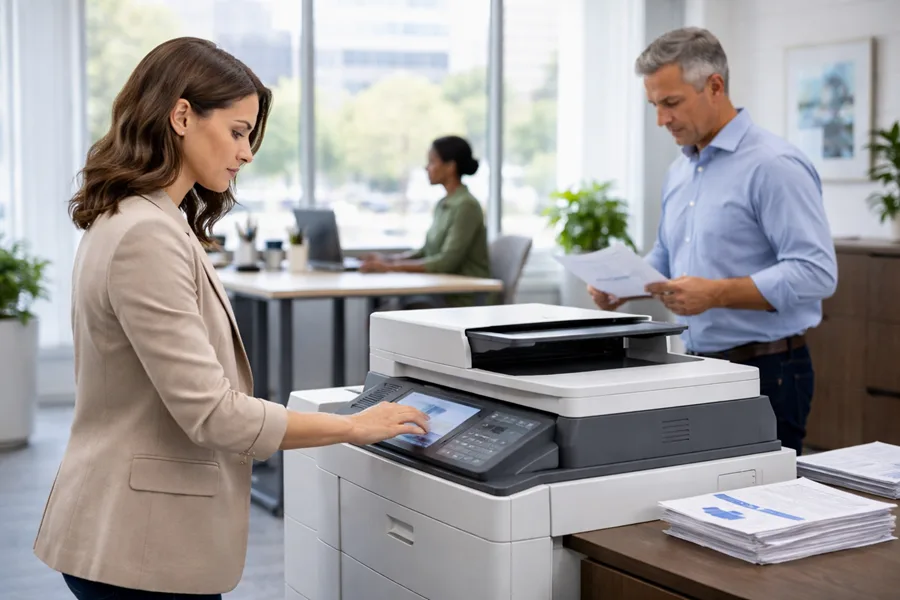
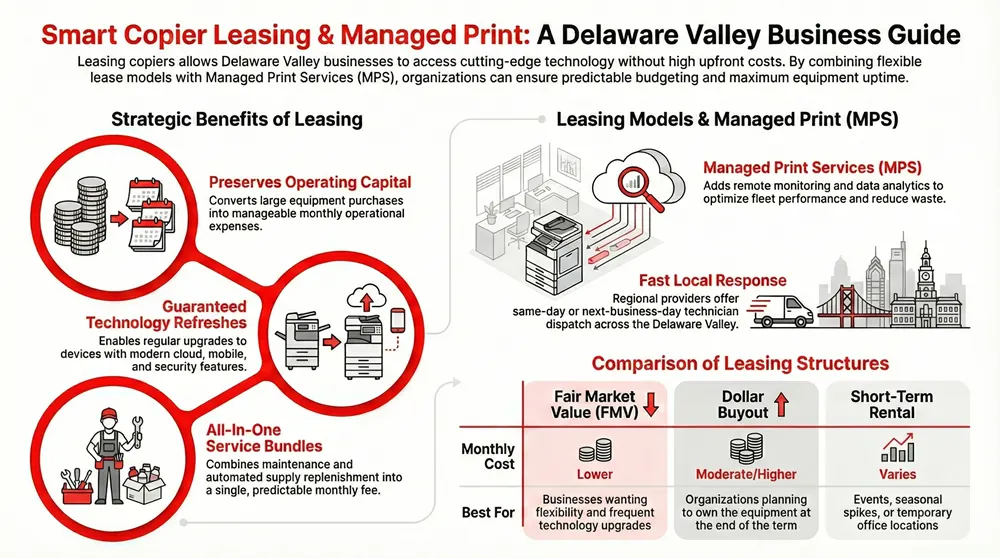
Leasing lets businesses get the equipment they need while protecting operating capital and keeping monthly costs predictable. Instead of a large one-time purchase, you pay a fixed monthly fee that can include service and supplies—shifting capital expense into an operational one and lowering upfront risk. Leasing benefits teams that need scalable document solutions, regular upgrades for cloud and mobile workflows, or tighter IT and facilities budgets. Below we explain how leasing preserves capital and supports steadier budgeting for Delaware Valley operations.
By spreading payments over time, leasing preserves cash for payroll, software, or other investments. Predictable monthly costs simplify cash-flow planning and align printing expense with actual use, helping avoid surprise repair bills. When paired with MPS, leasing often brings consolidated billing and clearer per-page cost reporting. The next section digs into the mechanics behind those budget advantages and how subscription-style models support predictable spending.
Leasing also speeds access to current printing technology and modern security features without owning equipment that could become obsolete. Lease-end upgrade options let organizations move to devices with better cloud integration, mobile/BYOD printing, and stronger document encryption. Regular refresh cycles close compatibility gaps with evolving workflows and help meet compliance and sustainability goals. That technology flexibility is important when choosing the lease type that fits your organization’s pace of change.
Finally, leasing can reduce downtime and internal workload because service and supplies are commonly bundled. Remote monitoring and local technician dispatch shorten repair times and keep devices online—critical for high-volume offices in legal, healthcare, and financial services across the region. Scheduled maintenance and automatic supply replenishment remove procurement hassles so your team can focus on core work. Next, we compare the flexible lease types available locally.
How Does Leasing Preserve Capital and Ensure Predictable Budgeting?
Leasing turns a large, single purchase into manageable monthly payments so cash stays available for staff, software, or facilities. Lease payments typically cover equipment use and can include maintenance, parts, and supplies, which makes monthly costs easier to forecast. For finance teams, treating the cost as an operating expense simplifies budgeting and fits with subscription-based accounting practices many organizations already use. Businesses facing growth, seasonal volume changes, or fast technology shifts often prefer leasing to avoid owning outdated equipment.
Leases also reduce the work involved in disposing of or reselling equipment at end-of-life, since many agreements include return or upgrade options. That flexibility lets you move to devices with modern cloud connectors or stronger security without a new capital approval. Predictable payments and bundled services make total cost of ownership clearer, helping departments plan with confidence. With budgeting benefits in mind, the next section covers technology advantages leasing enables.
What Are the Benefits of Accessing the Latest Copier Technology?
Leasing keeps you on current features—cloud integration, secure authentication, mobile printing, and energy-saving modes—without the capital expense of buying and replacing hardware. Lease terms typically align with hardware refresh cycles, so you can upgrade at term-end to devices that support tighter cloud connections and new subscription features. Access to modern tech speeds productivity through scan-to-cloud workflows, automated routing, and better mobile support for hybrid teams.
Newer devices also strengthen security and compliance with built-in encryption, user authentication, and secure print release to reduce data leakage risk. Energy-efficient models lower utility use and support sustainability targets. As you weigh these benefits, the next section compares lease structures so you can match technology access and budget to the right approach.
What Flexible Copier Leasing Options Are Available in Delaware Valley?
Delaware Valley businesses can choose from several leasing models that match financial and operational goals: Fair Market Value (FMV) leases, dollar buyout leases, and short-term rentals. Each balances monthly cost, end-of-term ownership, and upgrade flexibility. The right option depends on print volumes, refresh cadence, and capital strategy. Below is a quick comparison to help decision-makers match needs to lease types, followed by a practical explanation of each model and how local providers support them.
Compare common lease types and typical term expectations for regional businesses:
This comparison highlights the trade-offs: FMV lowers payments and keeps upgrade paths open, dollar buyout leads to ownership, and short-term rentals cover temporary needs. Next we define each model in practical terms for Delaware Valley operations.
What Is a Fair Market Value Lease and How Does It Work?
An FMV lease bases monthly payments on the device’s expected residual value at term-end, which keeps payments lower than leases that build in ownership. At the end of the term you can usually return the equipment, renew the lease on newer devices, or extend the agreement—choices that let you stay current without new capital outlays. FMV suits businesses that prioritize flexibility and steady cash flow, especially where technology and security needs change frequently.
FMV leases reduce the risk of owning outdated hardware and align refresh cycles with operational needs—useful for teams relying on advanced scanning, cloud connectors, or multi-factor authentication. Lower monthly costs often free budget for software or additional devices across locations. Understanding FMV helps when weighing a lower payment against the desire to own equipment long term.
How Does a Dollar Buyout Lease Differ and Who Should Choose It?
A dollar buyout lease structures payments so you can take ownership at term-end for a nominal fee. Monthly payments are higher than FMV because the lease amortizes more of the device cost, but ownership can make sense for organizations with stable print demand and long-term facilities plans. A buyout is a good fit when a device’s reliability and operating costs justify capital ownership.
Owning equipment simplifies asset tracking and depreciation for some finance teams, but it also means planning for replacement and disposal later. Organizations considering buyout should factor in long-term maintenance and whether the device will meet evolving security and cloud requirements over its lifespan. For temporary needs, short-term rentals may be a better match.
When Are Short-Term Copier Rentals Ideal for Businesses?
Short-term rentals are ideal for temporary demands—events, pop-up locations, seasonal staffing surges, or while you wait for permanent installations. Rentals usually include delivery, setup, and support, giving fast, low-commitment access without long contracts. This option works well when hybrid work creates unpredictable peaks or when teams want to test workflows before committing to a longer lease.
Rentals also keep operations running during repairs or office moves by providing immediate replacement devices. Many Delaware Valley organizations combine rentals with longer-term leases to balance stability and flexibility across fluctuating demand. Knowing typical rental logistics helps you plan deployments and return timelines.
Which Advanced Copier and Printer Models Can You Lease in Delaware Valley?

Leasing programs in the Delaware Valley cover a full range of devices—multifunction printers (MFPs), color and black & white copiers, and wide-format printers—each suited to different volumes and use cases. The goal is to match device capabilities (scanning, finishing, secure print, cloud connectors) to your document workflows so equipment supports your operational goals. Leading manufacturers available through regional leasing channels include Ricoh, Sharp, Xerox, and Canon; brand choice depends on required features and service preferences.
Below is a device-type mapping to help match business needs to typical features and use cases:
This device mapping helps teams select the right family for their workload and budget. Next, we look at the specific productivity features MFPs bring to everyday work.
What Features Do Multifunction Printers Offer for Business Efficiency?
MFPs combine printing, scanning, copying, and often faxing with digital workflows like scan-to-cloud, OCR, and automated routing to reduce manual handling. These capabilities speed tasks such as invoice processing and client onboarding by converting paper into searchable files and routing them where they belong. Mobile printing and secure release add flexibility for hybrid teams—print from a phone and pick up documents securely on-site.
Built-in templates and automated workflows cut repetitive work and help enforce compliance by ensuring consistent handling of sensitive documents. Remote monitoring and firmware updates also keep devices current with the latest encryption and authentication features. With those benefits in mind, the next section explains how color and monochrome devices serve different roles.
How Do Color and Black & White Copiers Meet Different Business Needs?
Color copiers are best for branded materials, client-facing reports, and marketing where color fidelity matters. Black & white devices deliver the lowest cost-per-page for high-volume text printing. The choice is a trade-off between output quality and consumable costs: color gives richer visuals at higher ongoing expense, while monochrome optimizes recurring costs for administrative printing. Many organizations use a mixed fleet to reserve color for functions that need it and keep overall costs down.
Choosing the right mix means measuring monthly color vs B&W page ratios and comparing lease ranges for each device class. A balanced fleet aligned with departmental needs—combined with MPS reporting—reduces total printing spend. Once device selection is set, brand and local service availability become the final considerations.
Why Choose Leading Brands Like Ricoh, Sharp, Xerox, and Canon for Leasing?
Major manufacturers deliver reliability, broad feature sets, and large service ecosystems that suit lease deployments. Ricoh, Sharp, Xerox, and Canon each offer distinct firmware, finishing options, and security tools; local vendors typically stock multiple brands so you can match features to requirements. Choosing a recognized brand often simplifies IT integration and ensures parts and service are available.
Working with a local leasing partner that offers multiple manufacturers lets you pilot platforms before committing and keeps you connected to manufacturer-backed firmware updates and security patches. Brand selection should consider uptime history, cloud and mobile connector parity, and local technician availability to minimize repair times. These factors naturally lead into how managed print services improve leasing outcomes across fleets.
How Can Managed Print Services Enhance Your Copier Leasing Experience?
Managed Print Services (MPS) add monitoring, supplies management, and analytics on top of leased equipment to lower total printing costs and improve efficiency. MPS uses remote diagnostics and usage reporting to predict maintenance needs, consolidate billing, and optimize device placement and fleet size. Combined with leases, MPS gives centralized visibility into printing behavior so you can make data-driven decisions that reduce per-page costs and environmental impact. The section below shows the MPS components that drive measurable ROI.
MPS cuts reactive maintenance through proactive alerts and automates toner replenishment so devices stay online with fewer interruptions. Reporting highlights cost centers and enables internal chargeback or allocation models that encourage responsible printing. Paired with security policies, MPS strengthens document governance and simplifies vendor management.
This table shows how core MPS services translate into operational improvements and support smarter lease decisions. Next, we summarize the key MPS benefits for Delaware Valley organizations.
What Are the Key Benefits of Managed Print Services in Delaware Valley?
MPS reduces printing costs by right-sizing fleets, enforcing usage policies, and cutting waste with smarter supplies management. Remote monitoring captures meter data and device health so providers can schedule predictive service instead of reacting to failures—vital for high-volume offices in legal and financial sectors. Centralized reporting improves budgeting accuracy and supports sustainability goals by tracking toner use and device energy profiles.
MPS also streamlines procurement and vendor management by combining service, supplies, and billing into one relationship, freeing internal staff from daily device tasks. Smaller organizations gain enterprise-grade monitoring they wouldn’t manage on their own. With those advantages in mind, the next subsection explains how MPS supports maintenance and repairs.
How Does Managed Print Service Support Copier Maintenance and Repairs?
MPS providers use remote diagnostics to spot issues early, dispatch local technicians, and schedule preventive maintenance to avoid unexpected failures. This proactive approach reduces long downtimes by catching hardware or firmware problems before they escalate, and it often includes spare-parts planning and consumables shipments. Local service relationships shorten technician travel time, speeding repairs for businesses across the Delaware Valley.
Bundling maintenance with leasing simplifies escalation and delivers consistent service levels across your fleet, cutting administrative overhead. Remote firmware management helps keep devices secure and compliant with evolving standards.
With these service dynamics clear, we’ll next look at where leasing and MPS options are available across the region.
Which Areas in Delaware Valley Are Served by Copier Leasing Services?
Copier leasing services in the Delaware Valley cover major business hubs and surrounding communities, offering tailored device mixes and deployment options for urban and suburban settings. Providers prioritize fast local response, flexible delivery windows, and service coverage that matches municipal and commercial needs. In practice, localized offerings often include same-day or next-business-day technician dispatch depending on proximity and stock.
Service-area coverage should shape fleet planning and redundancy—especially for organizations with multiple sites across Philadelphia, Wilmington, and Newark. Local knowledge helps providers plan routes, anticipate congestion, and stage supplies in high-demand zones. Below we outline what to expect in Philadelphia, Wilmington, and Newark.
What Copier Leasing Solutions Are Available in Philadelphia?
Philadelphia businesses can access everything from compact desktop printers for small teams to high-volume MFPs for legal, education, and finance sectors. Urban deployments focus on small footprints, strong security for shared environments, and flexible finishing options for client-facing materials. Local providers understand downtown logistics and plan installations to minimize disruption, supporting fast onboarding and consistent uptime across floors and satellite offices.
In metro areas, responsiveness centers on technician availability and efficient routing to meet quick repair expectations, and fleets often include redundancy to avoid single-point failures. These urban patterns contrast with Wilmington, where rentals and regional accessibility play a larger role.
How Does Wilmington Benefit from Printer Rental and Office Equipment Leasing?
Wilmington organizations often use short-term rentals for events, seasonal projects, and temporary expansions, gaining fast delivery and setup that avoid long procurement cycles.
Local rental options also let teams trial new workflows and bridge capacity gaps during peak periods. For growing businesses, flexible lease terms provide an easy way to scale device capabilities without large upfront purchases.
What Office Equipment Leasing Options Exist in Newark and Surrounding Areas?
Newark and nearby communities have access to tailored lease packages combining small-office MFPs, compact color printers, and optional MPS for reporting and remote support. Small businesses and municipal offices benefit from bundled plans that include installation, supplies, and preventive maintenance to simplify operations. Providers can design packages with small footprints and low per-page costs suited to tight offices and limited budgets.
Vendors serving Newark emphasize quick site assessments and straightforward quoting so small teams can pick devices that match monthly volume and finishing needs. These local options make it easier to pilot changes and scale when necessary, which ties directly into selecting the right leasing partner.
What Makes Associated Imaging Solutions the Premier Copier Leasing Provider in Delaware Valley?
Associated Imaging Solutions (AIS) is a regional partner offering copier, printer, and office-equipment leasing across Philadelphia and the Delaware Valley with local expertise and global-standard hardware. AIS provides flexible leasing options, access to major brands, and local support designed to reduce repair times and simplify service. Their focus is predictable budgeting, fast regional response, and energy-efficient device choices that meet security and sustainability expectations.
AIS pairs local technicians with manufacturer relationships so clients can choose top brands and receive timely on-site support. For organizations that need transparent billing and bundled maintenance, AIS offers lease structures that include service and supply management to minimize downtime. Below we explain how local knowledge and global standards work together and what to expect when partnering with AIS.
How Does Local Expertise Combined with Global Standards Benefit Your Business?
Local expertise delivers quick technician dispatch, efficient routing, and an understanding of area-specific requirements. Global standards ensure equipment supports modern security, cloud, and finishing features. Together, that means you get the responsiveness of a nearby partner plus the capabilities of major manufacturers. Local knowledge also helps tailor fleet designs to building access, parking, and staffing patterns common across Delaware Valley offices.
Working with a local provider reduces logistical friction for installs and repairs while giving access to manufacturer-certified devices with current cloud connectors and security patches. The end result is a reliable, modern printing environment that meets enterprise expectations without sacrificing regional responsiveness. Those service benefits are central to how AIS approaches customer support.
What Customer Support and Service Can You Expect from AIS?
AIS provides dedicated phone and email channels for leasing questions and emphasizes quick local response for service and maintenance, helping shorten repair times. Support typically includes on-site technician dispatch plus options for bundled maintenance and automatic supply replenishment to keep equipment working with minimal client effort. AIS’s local presence also streamlines multi-site rollouts and coordinated replenishment across nearby offices.
Clients can expect clear communication on service calls, consolidated billing options, and help integrating devices into existing document workflows. For the fastest service, contacting AIS by phone or email is the quickest way to get quotes and technical assistance tailored to Delaware Valley locations. These support elements reflect AIS’s commitment to sustainability and security in leasing.
How Does AIS Commit to Sustainability and Advanced Security in Copier Leasing?
AIS offers eco-friendly copier choices and highlights devices with energy-saving modes and efficient consumable use to help meet sustainability targets. Modern leased devices typically include secure print release, user authentication, and encryption to protect sensitive documents and data in transit.
By pairing energy-efficient hardware with secure printing protocols, AIS helps clients reduce environmental impact while protecting workflows from data leakage. This dual focus supports organizational goals for responsible operations and risk management and guides procurement choices when selecting lease terms and configurations.
Frequently Asked Questions
What are the advantages of Managed Print Services (MPS) when leasing copiers?
MPS complements leasing by providing proactive monitoring, supplies management, and analytics. That means fewer surprises: predictive maintenance reduces downtime and automated toner replenishment keeps devices running. Centralized visibility into printing behavior enables data-driven decisions that lower costs and improve efficiency. Integrated MPS helps optimize fleet size, enforce policies, and simplify billing—driving clear operational benefits.
How can businesses determine the right copier lease type for their needs?
Pick a lease type based on print volume, budget, and how often you need upgrades. FMV leases suit organizations looking for lower monthly payments and regular refreshes. Dollar buyout leases work when you plan to own the equipment at term-end. Short-term rentals are best for temporary needs. Evaluating usage patterns and ownership goals helps align your leasing strategy with financial and operational priorities.
What should businesses consider when selecting a copier brand for leasing?
Consider reliability, local service availability, and the feature set. Brands like Ricoh, Sharp, Xerox, and Canon offer proven performance and support networks that help minimize downtime. Also check how well a brand integrates with your IT systems and whether it meets security and cloud needs. Local technician responsiveness is a key factor in keeping operations running smoothly.
How do leasing agreements typically handle maintenance and repairs?
Many leases include maintenance and repairs as part of the package, which reduces administrative burden. Typical coverage offers routine maintenance, on-site repairs, and remote monitoring to catch issues early. Always review response times and the exact scope of coverage so the lease matches your uptime expectations and operational needs.
What are the environmental benefits of leasing copiers?
Leasing can support sustainability by providing energy-efficient devices and facilitating responsible recycling. Regular upgrades through leasing mean you can adopt newer, greener models more often. Combined with digital workflows, leased equipment can help reduce paper use and lower your overall environmental footprint.
Can businesses customize their copier leasing agreements?
Yes. Most providers let you tailor lease agreements—choose equipment, lease length, and service levels like maintenance and supply management. Discuss your priorities and constraints during negotiations so the agreement matches operational needs and budget.
Is Leasing or Buying a Copier Better for My Delaware Valley Business?
Leasing is usually the better choice when you want to preserve cash, get regular upgrades, and keep monthly costs predictable. Buying can make sense if your print volumes are stable long-term and ownership fits your capital plan. Leases offer refresh flexibility and bundled service to avoid surprise bills; buying may be cheaper over the full lifespan in some cases. Many organizations use a hybrid approach—leasing core devices and renting for temporary spikes—to balance cost and flexibility.
are included—so custom quotes are essential. What Services Are Included in a Copier Lease Agreement?
Common inclusions are installation, routine maintenance, remote monitoring, and options for supplies (toner) and on-site repairs—some agreements bundle these into a single monthly payment. Optional add-ons include MPS features, security modules, or priority response. Always review contract details—warranty, consumable responsibilities, and end-of-term choices—to ensure the lease meets your needs and budget.
How Can You Get a Custom Copier Lease Quote in Delaware Valley Today?
Requesting a custom lease quote starts with a few operational details so providers can size the right device and service package. Key items include monthly page volume, color vs B&W split, desired features, preferred lease term, and site location. Sharing these details speeds up accurate proposals and helps vendors recommend FMV, buyout, or rental options. Use the checklist below when requesting a quote.
Provide the following details when requesting a quote:
Monthly print volume broken down by B&W and color pages.
Desired device capabilities (MFP, finishing, secure print, cloud connectors).
Preferred lease term (e.g., 36–60 months) and budget range.
Site location and number of devices or locations requiring support.
Giving this information reduces back-and-forth and speeds accurate proposals. The next subsection explains what AIS needs for a personalized quote.
What Information Is Needed to Request a Personalized Lease Quote?
A complete quote request includes monthly page counts (B&W vs color), number of users or departments, required finishing and scanning features, desired lease term, and the delivery address. Helpful extras are current device models and pain points (frequent jams, long repair times) so the provider can tailor service levels and MPS recommendations. Accurate meter reads and sample job profiles let the leasing partner size devices correctly and propose cost-effective solutions.
How Quickly Can AIS Provide Leasing Solutions After Your Inquiry?
AIS focuses on fast local response for leasing and service coordination. Quote turnaround depends on how complete your information is and on device availability. For the fastest service, contact AIS by phone or email with the checklist above so they can review options and propose lease structures that match your needs. Local delivery and setup timelines vary by device and schedule but are typically faster when working with a regional partner that maintains inventory and local technicians.
165 Veterans Way, Suite 100A Warminster, PA 18974
Phone: 215-322-9145
Email: sales@aispa.us
Related Posts
— Managed Print Services in Delaware Valley

— Managed Print Services for Philadelphia Businesses