

Eco-Friendly Printing Solutions with MPS

February 17, 2026
 0 views
 0 comments
Sustainable Printing with Managed Print Services — Reduce Waste, Lower Costs, Meet CSR Goals
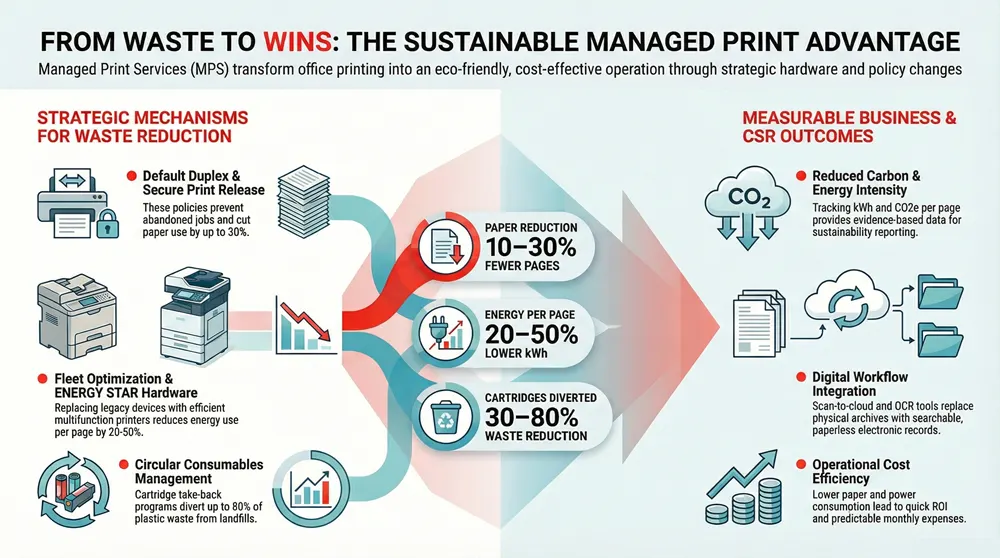
Smart, eco-friendly printing pairs better workflows, energy-efficient hardware, and responsible consumables management to cut environmental impact while trimming operating costs. This guide shows how Managed Print Services (MPS) turn policy, device management, reporting, and supplies programs into measurable sustainability wins. You’ll get practical tactics—duplex defaults, secure print release, digital document management, fleet right-sizing, ENERGY STAR® device selection, toner take-back, and KPI tracking—that turn “green” office goals into real cost savings and CSR outcomes.
Each section links a specific action to the environmental mechanism and the business result so procurement teams and facilities managers can act with confidence. We also show where local partners like Associated Imaging Solutions (AIS) fit into an MPS program without distracting from the technical guidance that drives results.
How Do Managed Print Services Enhance Sustainability in Office Printing?
Managed Print Services (MPS) centralize printer fleet oversight, enforce print policies, and deliver usage reporting to cut waste and energy use. MPS sets default behaviors (like duplex printing), consolidates devices, enables secure print release, and surfaces analytics that show where printing can be reduced—directly lowering pages printed, kWh consumed, and consumable disposal. The outcome is a greener, more efficient workplace: fewer single-use prints, less idle energy draw, and a more circular approach to toner and cartridge lifecycles. MPS also adds governance—print quotas, user-level reporting, and automated replenishment—that reduces surprises and makes progress measurable. Below we summarize the primary environmental mechanisms most organizations realize after implementing MPS.
This section outlines four primary mechanisms by which Managed Print Services improves sustainability:
- Reduce Paper Use: Policy controls and digital workflows cut unnecessary printing and lower pages per employee.
- Optimize Energy: Fleet optimization and ENERGY STAR® device choices reduce kWh per page.
- Recycle Consumables: Cartridge take-back and remanufacturing cut plastic waste and e‑waste.
- Enable Digital Workflows: Scan-to-cloud and DMS integrations replace physical archives with searchable electronic records.
These mechanisms reinforce one another: less paper demand reduces consumable use, which lowers disposal and transport emissions—creating a compounding sustainability effect.
What Are the Key Environmental Benefits of MPS?
MPS delivers measurable environmental benefits that bolster green-office programs. First, paper waste drops by enforcing duplex-as-default, routing large jobs to suitable devices, and using print release to prevent abandoned jobs—often yielding double-digit reductions in paper use. Second, energy savings come from replacing legacy printers with ENERGY STAR®-rated multifunction devices, consolidating peripherals, and applying stricter power-management settings to cut idle draw. Third, consumable lifecycle management—scheduled supplies and cartridge take-back—reduces plastic waste and hazardous disposal, lowering scope-related emissions. Together these benefits produce clear KPIs: fewer pages per employee, lower kWh per page, fewer cartridge disposals, and a smaller printing-related carbon footprint—assets for CSR reporting and procurement evaluations.
How Does AIS’s MPS Reduce Paper Waste and Energy Consumption?
Associated Imaging Solutions (AIS) delivers Managed Print Services, equipment leasing, and document management locally to help organizations meet eco-friendly printing goals. Our approach combines fleet optimization with digital workflows to right-size devices and reduce the total number of printers, while offering ENERGY STAR®-capable copiers to lower energy per page. Practically, AIS configures devices with duplex defaults, print release, and user quotas, and pairs those settings with scan-to-cloud and other document-management tools to remove routine print steps. Local service means faster upgrades and responsive maintenance, reducing downtime and accelerating sustainability gains for Philadelphia-area organizations. These examples show how a regional MPS provider puts strategy into practice on the ground.
What Strategies Does AIS Use to Reduce Paper Waste with Managed Print Services?
Cutting paper waste takes policy, device configuration, workflow redesign, and user engagement—steps MPS providers apply during discovery and deployment. AIS starts with a print assessment to find high-volume users and redundant devices, then standardizes settings like duplex-by-default and grayscale-first for non-essential jobs. We add authentication and print release to prevent abandoned prints, deploy quotas or cost-centers to shift behavior, and integrate digital document management to move recurring paper tasks into electronic workflows. Training and governance round out the program: user education, simple job redirection, and ongoing reporting sustain reductions and keep compliance high.
AIS applies these tactics through practical steps businesses can adopt:
- Duplex-by-Default: Configure two-sided printing for standard documents to cut single-sided pages roughly in half.
- Print Release Authentication: Require users to authenticate at the device to retrieve jobs—preventing accidental or forgotten prints.
- Digital Workflow Integration: Replace paper-heavy processes with scan-to-cloud, OCR, and e-signature handoffs for routine approvals.
These operational moves form a sequence: policy reduces immediate waste, authentication prevents accidental output, and digital workflows remove repeat print demand—together they lock in lasting paper reductions.
For Philadelphia organizations ready to act, request an MPS assessment from Associated Imaging Solutions to get a tailored quote and a device plan aligned with local sustainability goals.
How Does Duplex Printing and Print Release Prevent Unnecessary Printing?
Duplex printing and print release address two common causes of paper waste: single-sided defaults and unattended print jobs. Duplex-as-default flips standard documents to two-sided output automatically, cutting paper per document and reducing storage for printed records. Print release requires user authentication at the device before printing, preventing accidental sends and large uncollected queues; this simple behavior change curbs waste from abandoned jobs and misprints. Used together, these controls produce measurable drops in pages printed and raise user awareness of printing costs and environmental impact. The data they generate also helps refine quotas and target training—paving the way for wider digital workflow adoption.
How Does Digital Document Management Integrate with MPS to Promote a Paperless Office?
Digital document management systems (DMS) pair with MPS through scan-to-cloud, OCR, indexed storage, and workflow automation to replace many paper processes. When scanning routes into a DMS, documents become searchable electronic records that support approvals, archiving, and retrieval without printing; OCR turns images into text, enabling quick access and fewer reprints. Typical integrations include cloud storage connectors, automated retention policies, and e-signature handoffs that convert multi-step paper approvals into streamlined digital flows. This reduces print volumes, shortens cycle times, and improves retention compliance by creating a single source of truth for documents. As reprint rates and physical archives fall, organizations realize both environmental and operational gains from a digital-first approach.
How Can Energy Efficiency Be Improved Through Sustainable Hardware and Fleet Optimization?
Energy gains come from choosing efficient hardware, consolidating fleets, and using power-management features to cut idle consumption and peak loads. Replacing legacy single-function printers with ENERGY STAR®-certified multifunction devices typically lowers kWh per page because modern devices enter low-power modes faster, recover more efficiently, and consolidate functions. Fleet optimization analyzes usage to right-size machines—placing high-capacity MFPs for shared needs and limiting desktop units for occasional use—reducing the number of devices drawing standby power. Paired with scheduled shutdowns, sleep-mode tuning, and employee guidance on energy-aware printing, these choices reduce operating costs and carbon intensity per printed page.
*Estimates assume average U.S. electricity cost (~$0.15/kWh); actual savings depend on usage patterns and local rates.
This comparison shows that replacing older printers with ENERGY STAR®-rated MFPs and consolidating desktops can substantially cut per-device energy use, lowering costs and emissions across your organization.
The next section covers procurement and fleet strategies that help make these savings durable.
What Are the Benefits of ENERGY STAR® Certified Printers and Copiers?
ENERGY STAR®-certified printers and copiers lower electricity use through verified criteria for sleep modes, power management, and efficient print cycles. These devices generally use fewer kWh annually than older models, reduce cost per page, and provide documented efficiency credentials that simplify procurement. For sustainability programs, ENERGY STAR® gives procurement teams a defensible baseline: requiring the certification ensures consistent efficiency across leased and purchased equipment. Energy-efficient models also often include firmware and management features that speed recovery from sleep and support centralized power policies and reporting—linking hardware choices directly to measurable carbon and cost reductions.
How Does Fleet Consolidation and Power-Saving Features Reduce Carbon Footprint?
Consolidating the fleet cuts carbon by reducing device count, simplifying supply logistics, and concentrating print volume on fewer, more efficient MFPs. Replacing many single-function units with a smaller number of right-sized devices lowers cumulative standby draw and makes power-management scheduling easier. Power-saving features—aggressive sleep timers, scheduled off-hour shutdowns, and instant-on tech—further trim energy without hurting productivity. For example, moving from ten aging desktop printers to three shared MFPs can cut standby energy by more than half. Centralized firmware updates keep devices aligned with energy policies, making reductions measurable and repeatable.
What Consumables Management and Recycling Programs Support Eco-Friendly Printing?
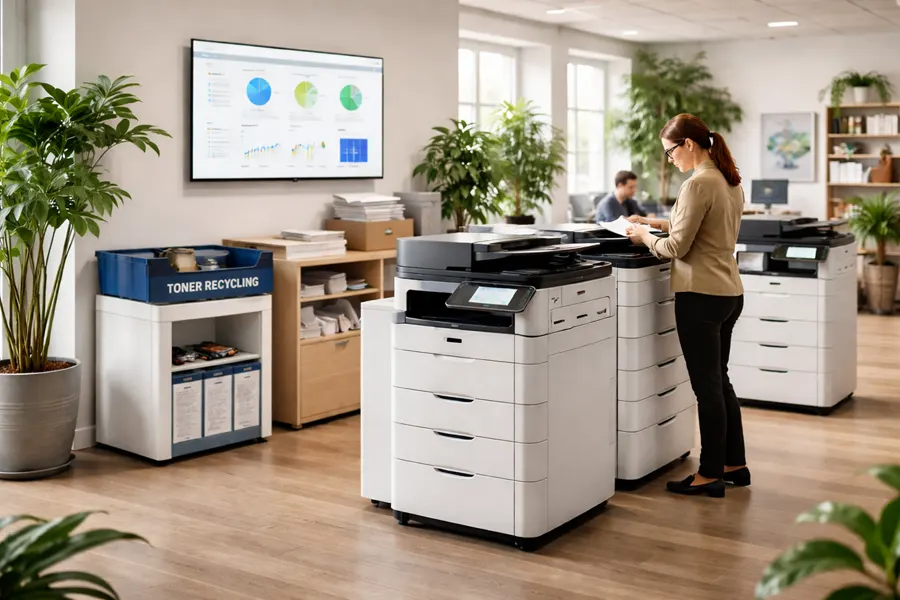
Good consumables management closes the loop on toner, ink, and paper by coordinating procurement, collection, and remanufacturing to minimize waste. MPS providers can centralize supply ordering to reduce excess packaging, stagger deliveries to lower transport emissions, and handle end-of-life returns through manufacturer or remanufacturer take-back programs. Beyond cartridge recycling, businesses can adopt FSC-certified recycled paper and eco-friendly inks to reduce lifecycle impacts. Coordinated programs combine procurement standards, secure collection workflows, and measured diversion metrics to show tangible environmental benefits. The table below compares common consumables programs by key attributes and typical diversion results.
These program features create measurable outcomes—cartridges recycled per year and plastic diverted from landfill—that feed sustainability reports and procurement scoring. Next we explain how cartridge recycling works and how to choose sustainable paper and ink.
How Does Toner and Ink Cartridge Recycling Reduce Environmental Impact?
Cartridge recycling diverts plastic, metal, and leftover toner from landfills and enables remanufacturing that avoids making new components. Typical workflows use secure collection bins, consolidated returns by the MPS provider, and processing by remanufacturers or manufacturers that reclaim materials for reuse. This reduces demand for virgin plastic and emissions tied to new production, and often lowers disposal costs. Tracked as KPIs—cartridges collected per year or metric tons diverted—recycling programs provide concrete evidence of circularity that supports CSR claims and procurement requirements.
What Sustainable Paper and Eco-Friendly Ink Options Are Available?
Choosing sustainable paper and eco-friendly inks lowers upstream impacts while keeping document quality high. Paper options include recycled-content sheets with strong post-consumer content and FSC-certified stocks that ensure responsible forest management. Eco-friendly inks—vegetable-based or low-VOC formulas—cut volatile organic compound emissions during printing and can simplify recycling or composting where appropriate. Procurement should favor recognized certifications (FSC, recycled-content labels), supplier transparency, and device compatibility to avoid misprints or waste. Pairing certified paper with efficient toner and remanufactured cartridges delivers the biggest lifecycle benefit for routine office printing.
How Can Businesses Measure and Report the Environmental Impact of Their Printing?
Measuring and reporting require clear KPIs, reliable data sources, and a repeatable cadence so sustainability claims are evidence-based and actionable. Core KPIs include pages per employee, year-over-year paper reduction percentage, cartridges recycled, kWh per page, and CO2e per page. MPS dashboards provide device-level usage and supplies data that map to carbon emission factors and energy rates to create a printing footprint. Establishing a baseline during the initial assessment lets organizations set targets and track progress through quarterly or annual reports that feed CSR disclosures. The next section lists practical tools and reporting features that support this approach.
This list shows core KPIs and why they matter:
- Pages per Employee: Measures printing intensity and helps set reduction goals.
- Paper Reduction % (YoY): Tracks progress from policy and workflow changes.
- kWh per Page / CO2e per Page: Captures energy and emissions intensity for reporting.
Together, these KPIs let organizations quantify MPS benefits and communicate progress to stakeholders and procurement panels.
What Tools Track Carbon Footprint and Sustainability KPIs for MPS?
MPS platforms and third-party carbon calculators turn device usage—pages printed, energy use, and supplies—into emissions and cost metrics using established factors. Typical MPS dashboards give per-device and per-user reports, alerts for unusual usage, and exportable data for sustainability reports. Third-party tools and spreadsheet calculators map pages and kWh to CO2e with regional energy factors to produce baselines and trends. Combining MPS reporting with procurement records for consumables and returns creates a comprehensive dataset for CSR disclosure and helps validate claims like paper reductions or cartridges recycled. Mapping raw usage to emissions units is the practical first step to credible sustainability reporting.
How Does Compliance with Environmental Standards Enhance Green Printing Initiatives?
Standards and certifications—ENERGY STAR® for devices and FSC for paper—add procurement rigor and credibility to green printing programs. Requiring these credentials in lease and purchase agreements reduces procurement risk, guarantees baseline sustainability performance, and simplifies vendor comparisons during RFPs. Standards also offer measurable criteria that can be integrated into MPS dashboards and sustainability reports, letting organizations show verifiable progress against recognized benchmarks. A minimal procurement checklist should include device efficiency certification, paper recycled-content or FSC certification, and a documented cartridge recycling pathway to support traceable claims.
What Are the Business Benefits of Adopting Green Managed Print Services?
Green Managed Print Services deliver benefits across cost, operations, and reputation. Cost savings come from lower paper, toner, and energy use combined with fewer service incidents thanks to centralized management and proactive maintenance. Operationally, MPS reduces administrative overhead through automated supplies replenishment, simplified billing, and consolidated vendor management—freeing IT and facilities teams for higher-value work. In the market, measurable sustainability performance supports CSR reporting, strengthens RFP responses, and improves stakeholder perception, creating strategic advantages for procurement and marketing. Below we summarize typical MPS interventions and expected KPI improvements to help decision-makers evaluate ROI.
The following table links common MPS initiatives to expected KPIs and typical results, illustrating the business case for green managed printing.
This mapping shows how targeted interventions deliver measurable financial and environmental returns that support payback calculations and CSR claims.
Why work with a local partner like Associated Imaging Solutions (AIS)? Consider these practical advantages that support the business case:
- Local expertise aligned with global standards—regional responsiveness paired with modern MPS practices.
- Flexible leasing options with predictable monthly payments and upgrade paths to avoid large capital expenditures.
- Contemporary technology and eco-friendly copier options to support ENERGY STAR® and sustainability goals.
- Hands-on local customer service that reduces downtime and speeds implementation for Philadelphia-area organizations.
These strengths help businesses capture operational savings and sustainability targets while keeping vendor management simple.
How Does Eco-Friendly Printing Lead to Cost Savings and Operational Efficiency?
Eco-friendly printing lowers direct and indirect costs by cutting paper, toner, and energy use and by reducing service incidents through consolidated fleet management. For example, lowering pages per employee via default settings and digital workflows shrinks paper spend and toner replacements, while ENERGY STAR® upgrades reduce energy bills through verified kWh reductions. Operational gains come from centralized supplies management, fewer device types to support, and better uptime via proactive maintenance—each reducing admin and IT effort. Combined, these changes often produce quick ROI: lower monthly expenses, fewer supply orders, and a smaller, measurable environmental footprint.
How Can Sustainable Printing Improve Corporate Social Responsibility and Brand Image?
Sustainable printing strengthens CSR and brand image with verifiable environmental outcomes—paper reductions and cartridges recycled—that can be shared in sustainability reports, marketing, and procurement responses. Measurable metrics, backed by MPS dashboards and certifications like ENERGY STAR® and FSC, create credible stories that resonate with customers, partners, and regulators. Internally, visible programs—cartridge collection stations and paper-reduction challenges—boost employee engagement and reinforce a culture of resource care. Externally, documented sustainability performance improves RFP submissions and supplier evaluations, turning operational improvements into market differentiation and reputational value.
Frequently Asked Questions
What is the role of digital workflows in eco-friendly printing?
Digital workflows are critical to reducing paper use. By using scan-to-cloud, OCR, and DMS platforms, teams can replace paper-heavy processes with searchable, shareable electronic records. That not only cuts printing but also speeds approvals, improves access, and lowers costs—making sustainability practical and measurable.
How can businesses ensure compliance with environmental standards in their printing practices?
Embed recognized certifications—ENERGY STAR® for devices and FSC for paper—into procurement criteria and contracts. Combine that with periodic audits, performance tracking, and clear vendor requirements to verify compliance and document progress against sustainability goals.
What are the financial implications of adopting Managed Print Services?
MPS typically reduces ongoing expenses for paper, toner, and energy while lowering administrative overhead through automated supplies and proactive maintenance. These savings, combined with predictable leasing options, usually deliver a clear and relatively quick return on investment.
Use MPS dashboards and carbon calculators to convert device usage—pages printed, energy consumed, and supplies used—into CO2e and cost metrics. Regular KPI reporting (pages per employee, kWh per page, cartridges recycled) creates a baseline and shows trends for CSR disclosures and continuous improvement.
What are the benefits of using remanufactured cartridges in printing?
Remanufactured cartridges reduce plastic waste by reusing components and lower procurement costs compared with new cartridges. When sourced and managed correctly, they support a circular model without sacrificing print quality—helping both budgets and sustainability targets.
How does employee engagement impact the success of eco-friendly printing initiatives?
Engaged employees make sustainability programs stick. Participation in awareness campaigns, using recycling stations, and following new workflows all cut printing and build a culture of stewardship—amplifying the technical changes made through MPS.
What are some common challenges organizations face when implementing sustainable printing practices?
Common obstacles include resistance to change, limited awareness of printing impacts, and technical integration issues with legacy systems. Overcome these with clear communication, practical training, and phased rollouts supported by reliable MPS partners and local service resources.
Related Posts
— Managed Print Services in Delaware Valley
— How MPS Reduces Print Costs for Your Business