

Tailored Flexible Copier Leasing Plans for Businesses

January 29, 2026
 0 views
 0 comments
Flexible Copier Leasing Built for Your Business — Customized Plans to Control Costs and Keep Technology Current

Flexible copier leasing gives businesses customizable commercial agreements to access multifunction printers and office copiers with predictable monthly payments, bundled service, and upgrade paths that match changing needs. This guide shows how a flexible lease shifts large capital purchases into manageable operating expenses, preserves cash flow, and makes regular hardware refreshes simple. You’ll get a clear look at common lease types, realistic monthly cost ranges, how service and software are often included, and practical decision criteria for law firms, healthcare offices, creative shops, and startups.
We also cover maintenance SLAs, tax and accounting considerations, mid-term upgrade mechanics, and sample monthly cost scenarios to help with real procurement choices. Where useful, we point to local options and a Pennsylvania-based example provider to illustrate next steps for businesses seeking office printer rental or commercial MFP leasing solutions. By the end, you’ll understand lease structures, how FMV and $1 buyout compare, and which questions to ask vendors when evaluating custom leasing offers.
What Are Flexible Copier Leasing Plans and How Do They Benefit Businesses?
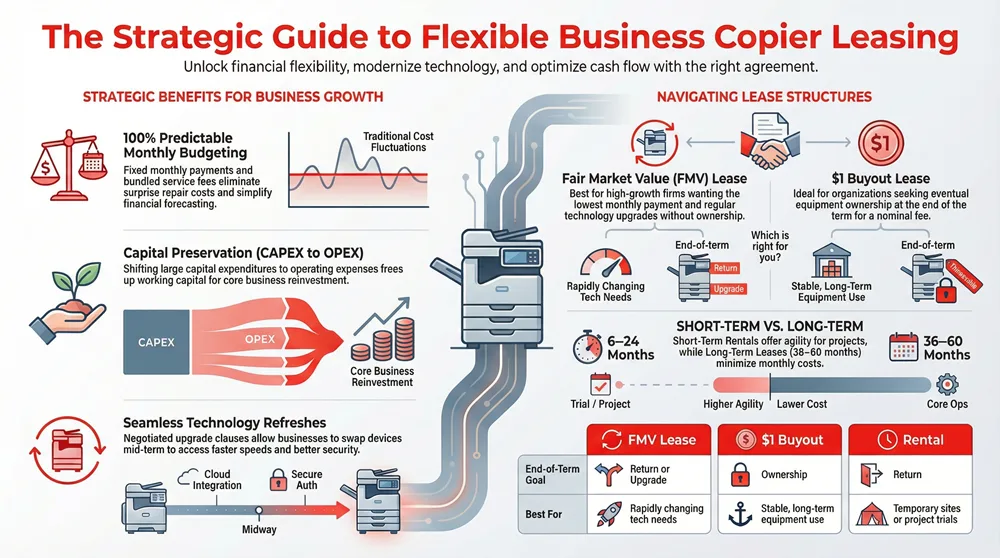
Flexible copier leasing packages combine equipment, maintenance, and upgrade options into tailored agreements so businesses pay predictable monthly fees while keeping operational flexibility. These plans specify the lease term, meter rates, and included services up front, lowering capital outlay and shifting lifecycle management to the lessor. The practical results: better cash flow, simpler budgeting, and faster access to modern MFP features like cloud integration and stronger security.
Here are the primary benefits at a glance for quick decisions and featured snippets.
Flexible copier leasing provides these top benefits:
- Predictable budgeting and improved cash flow through fixed monthly payments.
- Access to modern multifunction copiers without large upfront capital expenses.
- Inclusive maintenance and support that minimize downtime and administrative work.
- Upgrade options that allow technology refreshes during the lease term.
- Potential tax advantages when payments are treated as operating expenses.
Those advantages make flexible leasing useful across industries. Next, we explain how leasing improves cash flow and what modern copier features typically come with a lease.
How Does Flexible Leasing Improve Cash Flow and Budget Management?
Leasing converts a large one-time capital purchase into predictable operating expenses, helping businesses preserve working capital for core activities and growth. Lease payments are spread over a set term, which stabilizes monthly budgets and simplifies forecasting; predictable meter fees and bundled supplies cut down on surprise charges.
For example, an entry-level office copier on a short-term lease may require only a fraction of a purchase down payment, while midrange MFPs spread higher capability costs over 36–60 months. That flexibility supports startups and seasonal operations that need to protect liquidity, and it lets established firms align equipment capacity with growth plans. Clear monthly budgeting and lower initial outlay free up capital for reinvestment — and that brings us to the common technology features included in modern leases.
What Technology Features Are Included in Modern Copier Leases?
Typical lease fleets include features such as high-speed color printing, duplex scanning, advanced finishing, cloud integrations, secure user authentication, and diagnostic tools that flag service needs before devices fail. Together these capabilities boost productivity, protect sensitive documents with encryption and pull-printing, and enable mobile or cloud workflows that reduce paper bottlenecks. Energy-efficient models and eco-friendly toner options are also common, lowering total cost of ownership and supporting sustainability goals. Leasing makes it easier to adopt document management integrations and AI-assisted maintenance without a big upfront investment—helpful when choosing the right lease type for your business.
Which Copier Lease Options Are Available for Different Business Needs?
Businesses typically choose among fair market value (FMV) leases, $1 buyout leases, short-term rentals, and longer-term capital leases. Each maps to different financial and operational priorities. The key difference is the end-of-term outcome: FMV maximizes flexibility, $1 buyout leads to ownership, short-term rentals fit temporary needs, and long-term capital leases lower monthly payments while reducing mid-term flexibility.
AIS note: For organizations exploring custom leasing, Associated Imaging Solutions (AIS) offers FMV and $1 buyout structures and will tailor terms and payment schedules to your growth plan and budget. This regional example shows how local providers deliver these lease types along with installation and service.
What Is a Fair Market Value Lease and When Is It Ideal?
An FMV lease is an operating lease where you pay for equipment use during the term and then return, renew, or buy the device at its fair market value at term end. FMV is ideal for businesses that want access to current copier technology without keeping assets on their balance sheet. The lessor assumes residual-value risk, which supports regular fleet refreshes as technology advances. If you expect rapid growth or shifting workflow needs, FMV gives operational agility without a long-term ownership commitment.
How Does a $1 Buyout Lease Compare to Other Lease Types?
A $1 buyout lease structures payments so you effectively own the equipment at the end for a nominal $1. It generally means higher monthly payments than FMV but lower total lifetime cost if you plan to use the device long-term. The trade-off is reduced mid-term flexibility and potentially bigger monthly outlays. Organizations that want predictable long-term costs and eventual ownership often favor $1 buyout leases—just be sure to model total cost of ownership against your upgrade needs.
What Are the Differences Between Short-Term and Long-Term Copier Leases?
Short-term leases (6–24 months) give flexible, higher-cost-per-month access to copiers for temporary locations, projects, or trials. Long-term leases (36–60 months) spread costs further, lowering monthly payments but potentially limiting mid-term upgrades. Short-term rentals reduce commitment and let you scale quickly, but they typically carry higher meter rates. Long-term agreements are more economical when needs are stable; negotiating upgrade clauses up front can protect flexibility. Choose based on growth forecasts, project timelines, and how important ongoing access to new technology is for your business.
How Can Small Businesses and Startups Benefit from Custom Copier Rental Plans?
Custom copier leasing helps small businesses and startups by minimizing upfront capital expenditure, enabling fast deployment, and bundling maintenance so internal teams aren’t tied up with printer support. Tailored leases scale with headcount and seasonal demand, use meter-based billing for variable volumes, and let you add capacity for busy periods. Predictable monthly payments and inclusive support free small teams from printer maintenance, while modern MFP features let you deliver professional documents without heavy investment.
Key cost considerations include the monthly lease fee, meter/toner charges, overage rates, and installation or onboarding fees:
- Monthly Lease Fee: Covers equipment use and spreads cost over time.
- Metering and Consumables: Per-page charges affect total monthly spend.
- Service and Supplies: Bundled support reduces surprise service bills.
- Overage Rates: Exceeding contracted page volumes raises monthly cost.
What Are the Cost Considerations for Small Business Printer Leases?
Costs depend on device class (entry, midrange, high-volume), color vs. mono, meter rates, warranty and supplies inclusion, and contract length. Entry-level units suit light office use; midrange MFPs fit busy workgroups needing scanning and finishing; high-volume devices serve creative shops or departments with heavy print needs. Look at total monthly cost—base lease plus per-page charges—rather than just the base payment. To save, consider a slightly higher-tier device to avoid overage fees, negotiate included toner, and pick a term that balances flexibility with lower monthly pricing. Clear cost transparency during negotiation prevents surprises and keeps budgeting predictable.
Which Industry-Specific Copier Leasing Solutions Does AIS Offer?
Associated Imaging Solutions matches device features and lease terms to industry needs: secure workflows for healthcare, accurate color and wide-format options for creative agencies, and document-retention tools for law firms. AIS provides local installation and hands-on onboarding so clients can set up secure scanning, HIPAA-aware workflows, or finishing options with minimal downtime. Flexible leasing and upgrade pathways let small firms adopt the right features while keeping monthly budgets manageable. For businesses in Pennsylvania and the Delaware Valley, AIS’s local presence simplifies deployment and ongoing support to meet industry and compliance requirements.
What Are the Key Commercial Copier Lease Benefits for Growing Businesses?
For growing companies, leasing supports scalability, predictable operating costs, reduced admin work through bundled maintenance, and clear upgrade paths to keep fleets current. Leasing aligns equipment to staffing and output needs, and maintenance-inclusive agreements minimize downtime with proactive service and regular consumable delivery. Predictable payments simplify forecasting, and in many cases lease payments can be treated as operating expenses, which may improve short-term financial metrics.
Below is a table mapping key lease benefits to how they work and real business examples to quantify impact for procurement decisions.
These examples show how leasing supports growth by aligning equipment strategy with business priorities and freeing capital for revenue-driving initiatives.
The next section explains how maintenance and service are commonly included in leases and why SLA metrics matter for uptime.
How Do Lease Agreements Include Maintenance and Support Services?
Most leases bundle maintenance—parts replacement, on-site service calls, and consumables management—so your devices stay operational with minimal internal effort. Service level agreements (SLAs) spell out response times, parts availability, and escalation paths; typical metrics include next-business-day response or same-day critical repairs for high-volume devices. Bundled maintenance reduces unexpected repair costs and provides single-vendor accountability for service and billing. Local technicians and rapid-response coverage directly affect uptime and user satisfaction, so include clear SLA terms when evaluating offers to judge total service reliability.
What Tax Advantages and Upgrade Options Are Available with Copier Leasing?
Leasing can offer tax benefits because payments are often treated as operating expenses rather than capital assets, which can simplify accounting and preserve borrowing capacity. Tax treatment varies by jurisdiction and accounting policy, so consult your accountant for specifics. Upgrade options are commonly negotiated into leases and can include mid-term swaps, renewal credits, or trade-in allowances to support technology refreshes without large extra costs. These mechanisms let companies add security features, higher-speed MFPs, or expanded finishing as needs change while keeping monthly costs predictable.
Why Choose Associated Imaging Solutions for Your Flexible Copier Lease in Pennsylvania?
Associated Imaging Solutions (AIS) is a Philadelphia-area provider of copier and printer leasing, sales, and office equipment services across Pennsylvania and the Delaware Valley. AIS focuses on flexible lease options, low or no upfront costs, manageable monthly payments, and local, hands-on customer service including installation and onboarding. We offer state-of-the-art multifunction copiers with eco-friendly choices, and practical benefits like upgrade options and unlimited-print offers on select leases. For businesses in Philadelphia, Warminster, and the Delaware Valley, AIS’s local presence means faster service and regionally focused support.
AIS’s regional strengths and service offerings make us a practical choice for businesses that need tailored leasing and responsive on-site support. Consider these core value propositions when choosing a local leasing partner.
Key AIS value propositions:
- Local on-site support in Pennsylvania and the Delaware Valley to reduce repair lead times.
- Flexible leasing options, including FMV and $1 buyout structures to match financial goals.
- State-of-the-art multifunction copiers and eco-friendly choices to support sustainability goals.
To learn more about tailored solutions or discuss your specific needs, you can contact AIS for a consultation.
How Does AIS Provide Unmatched Customer Service and Local Support?
AIS delivers hands-on local support with technicians who install equipment, perform on-site service, and provide user training to speed team adoption. Regional coverage and fast response times shorten repair windows compared with remote-only models, and 24/7 support options help address urgent issues outside standard business hours. Local installation also streamlines onboarding, ensuring devices are configured for secure network integration and document workflows. If minimal downtime and close vendor collaboration matter, AIS’s local service model complements the financial and technical benefits of flexible leasing.
What Do Customer Testimonials Reveal About AIS’s Leasing Experience?
Customer reviews typically highlight reliable service, smooth transitions to new equipment, and satisfaction with inclusive leases that reduce administrative overhead. Common themes include straightforward billing, prompt service responses, and the convenience of bundled maintenance and supplies. These patterns suggest AIS’s practical delivery—installation, local support, and upgrade options—resonates with regional businesses. Prospective buyers should review provider testimonials directly to confirm fit and see real examples of how leasing impacted uptime and costs.
What Are the Most Common Questions About Flexible Copier Leasing?
We answer common procurement and operational questions in straightforward terms so decision-makers can compare options quickly. The most frequent queries concern monthly cost ranges, mid-term upgrades, contract exit options, and how meter charges affect total cost.
Next, we provide direct ranges for typical monthly lease costs.
What Is the Typical Monthly Cost to Lease a Business Copier?
Typical monthly lease costs depend on device class and included services. These ranges assume a baseline lease term and may exclude per-page charges for color or high-volume printing; total monthly expense equals the base lease plus metered usage and any supplies bundles. Small offices often choose entry-level or lower-midrange devices and focus on lowering per-page costs through accurate volume estimates. Budgeting accurately requires assessing expected monthly page volumes, color needs, and whether maintenance and supplies are included.
Can You Upgrade or Change Your Copier During a Lease Term?
Yes—upgrades or equipment changes during a lease are generally possible but depend on contract terms. Options typically include mid-term swaps, trade-ins, or negotiated upgrade clauses that recalibrate monthly payments. Some lessors let you exchange devices for newer models via a lease amendment based on residual values; others offer renewal credits at term end for upgrades. Potential costs can include termination fees, adjusted monthly payments, or changed meter tiers; negotiating clear upgrade pathways at contract start reduces uncertainty and helps you plan technology refreshes without unexpected expense.
Frequently Asked Questions
What Should Businesses Consider When Choosing a Copier Lease Type?
When choosing a lease type, evaluate operational needs, budget limits, and long-term goals. Key factors: expected duration of use, whether ownership matters, total cost of ownership over the term, printing volume, and required features like color or high speed. These considerations help you decide between FMV, $1 buyout, or short-term rentals.
How Can Businesses Ensure They Get the Best Lease Terms?
To secure strong terms, compare offers from multiple vendors and understand the total cost: monthly payments, meter rates, and fees for maintenance or supplies. Negotiate upgrade options and SLAs up front, and check references or reviews for vendor reliability. Clear comparisons and good negotiation lead to better, more predictable agreements.
What Are the Risks of Copier Leasing for Businesses?
Risks include unexpected costs if you exceed contracted page volumes, unfavorable maintenance terms, or being locked into outdated technology on long-term leases. Early termination fees and upgrade limits can also be costly. Careful contract review and negotiating flexibility where possible mitigates these risks.
How Do Maintenance and Support Services Work in Copier Leases?
Maintenance and support are usually bundled, covering parts, on-site repairs, and consumable management. SLAs define response times and service expectations, which vary by agreement. Clarify SLA details during negotiation to ensure timely support and minimal downtime.
What Are the Tax Implications of Copier Leasing?
Leasing can provide tax advantages because payments are often treated as operating expenses rather than capital purchases, simplifying accounting and preserving borrowing capacity. Tax treatment depends on jurisdiction and accounting policy, so consult your tax advisor for specifics.
Can Copier Leases Be Customized for Specific Industry Needs?
Yes. Providers tailor lease terms and device features to industry requirements—secure printing for healthcare, high-quality color for creative agencies, or retention features for legal firms. Custom SLAs, maintenance options, and upgrade paths can be included to match your workflows. Share your industry needs during the leasing process to get the best fit.
Related Posts
— Managed Print Services in Delaware Valley

— Managed Print Services for Philadelphia Businesses