


Managed Print Services in Chester County, PA

January 1, 2026
 0 views
 0 comments
Cut Costs, Secure Documents, and Simplify Your Printing
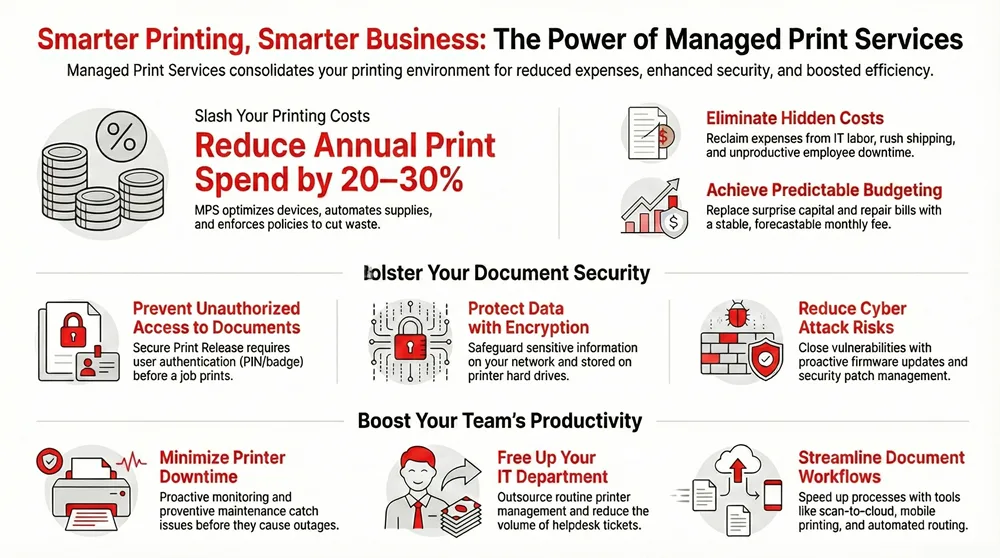
Managed Print Services (MPS) bring a company’s printers, supplies, security, and document workflows under one coordinated program to lower costs and keep operations running smoothly. This guide explains what MPS does, how it delivers measurable value for Chester County, PA businesses, and which levers — device optimization, supply management, security, and workflow integration — drive the biggest returns. You’ll get a clear overview of core MPS components, concrete ways organizations cut printing expenses, essential print security controls, and sustainability practices that reduce waste. We also walk through a typical implementation (assessment → deployment → ongoing management) and outline what to expect from local providers, including a close look at Associated Imaging Solutions (AIS). The content is built to answer local searches like “managed print services Chester County PA” and “print management West Chester” while offering practical checklists, comparison guidance, and FAQs to help you decide. Start by learning the basic elements that make MPS effective and how they translate into steadier budgets and less waste.
What Are Managed Print Services and How Do They Benefit Chester County Businesses?
Managed Print Services centralize how a business handles printing: device monitoring, supply replenishment, maintenance, security, and reporting all work together to drive efficiency and lower total print spend. MPS collects usage data, applies policies, and optimizes where machines sit so the right device serves the right users — cutting unnecessary color prints and reducing duplicate machines. For businesses in Chester County, that typically means lower operating costs, simpler budgeting through predictable service plans, and stronger document security that supports local compliance needs. In short, MPS turns a scattered printer fleet into a managed service aligned with your business goals.
What Components Make Up Managed Print Services?
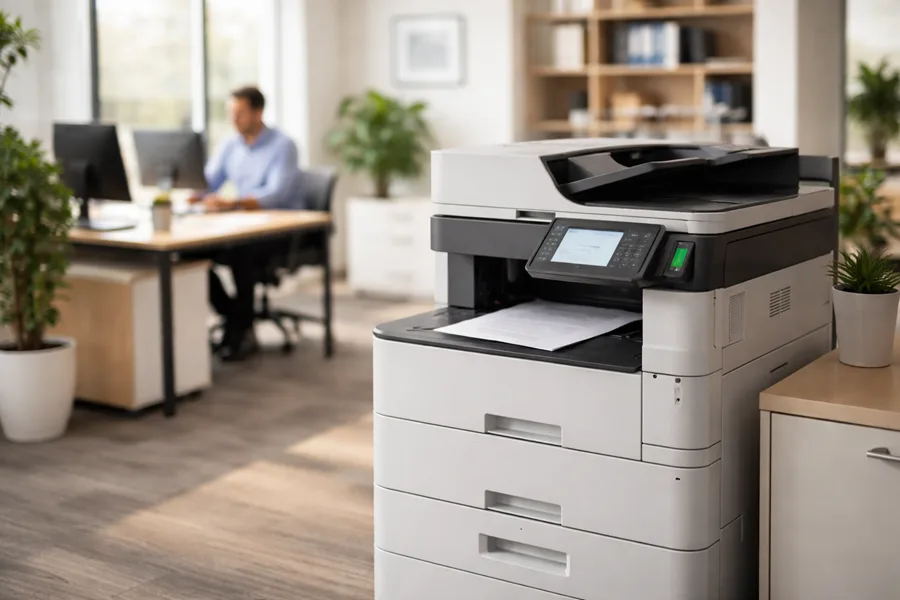
An effective MPS program usually includes a fleet assessment, automated supply management, remote device monitoring, preventive maintenance, enforceable print policies, and straightforward reporting. A fleet assessment catalogs devices and usage to recommend consolidation or right-sizing. Automated supply management prevents stockouts and eliminates rush shipping. Monitoring and preventive maintenance reduce downtime by catching issues early, and reporting delivers useful metrics — pages per device, cost-per-page, and more. Together, these pieces create a predictable, efficient printing operation where each element supports the others.
How Does Managed Print Services Improve Print Management and Efficiency?
MPS turns usage data into practical actions: centralized reporting highlights underused devices, policy enforcement reduces single-sided and unnecessary color jobs, and device consolidation removes redundant machines. Standardized drivers and print queues cut helpdesk complexity, while automated toner fulfillment and proactive servicing reduce unexpected outages. The result is fewer interruptions, less admin time spent on printers, and a measurable drop in cost-per-page — freeing staff to focus on higher-value work instead of routine printer issues.
How Can Managed Print Services Reduce Printing Costs for Chester County Businesses?
MPS lowers expenses through device optimization, smarter supply management, predictable billing, and user policies that reduce waste. Each mechanism attacks a common cost driver — too many devices, unmanaged supplies, emergency repairs, and user behavior — so savings build across the operation. For many Chester County organizations, a predictable monthly plan replaces surprise capital and repair bills, making budgeting clearer. Below are the primary cost-reduction mechanisms and how each contributes to savings.
- Device consolidation: Replace multiple underused machines with fewer, better-placed devices to cut fixed costs.
- Supply management: Automate toner and consumable replenishment to avoid emergency shipments and spoiled stock.
- Usage policies and print routing: Enforce duplexing and black-and-white defaults to reduce paper and color consumption.
- Proactive maintenance: Prevent costly breakdowns and downtime with scheduled servicing and remote diagnostics.
Together these measures create a reliable baseline for calculating cost-per-page and let finance teams forecast printing expenses instead of reacting to unpredictable repairs or replacements.
Intro to the cost comparison table: The table below summarizes common cost-reduction mechanisms and the direct value they deliver in typical Chester County print environments.
This table makes it clear which cost source each mechanism targets, helping organizations prioritize the interventions that will deliver the best short- and long-term returns. Next, we quantify typical savings ranges and show how predictable billing supports planning.
What Are the Typical Cost Savings and Budget Predictability with MPS?
Industry analyses show that well-run MPS programs can produce meaningful reductions in overall print spend by combining operational improvements with stable billing. Reports typically express savings as a percentage of prior print budgets, and predictable monthly fees replace volatile capital and emergency repair costs. Moving from a reactive model to a managed approach turns one-off large expenses into forecastable service fees that finance teams can budget for. The example table below illustrates common ROI scenarios by business type using industry-average framing rather than proprietary claims.
These examples show how fewer devices, automated supplies, and fixed monthly costs combine to make print spending more predictable and often lower overall. Identifying hidden costs helps explain why many organizations see returns soon after MPS deployment.
Which Hidden Print Costs Does MPS Help Eliminate?
Hidden costs include IT time spent on printer support, rush consumable deliveries, wasted energy from inefficient devices, and lost productivity while employees wait for prints or resolve errors. MPS tackles these with automated supply replenishment, proactive servicing, and user policies that curb unnecessary printing — cutting indirect labor and downtime costs. Tracking metrics such as helpdesk tickets per device and pages per employee surfaces these hidden expenses and measures improvements over time. Often, eliminating these indirect costs forms a large portion of realized savings and strengthens the ROI case for Chester County businesses.
Empirical Study on Managed Print Services Pricing and Customer Value
This paper examines managed services within MPS contracts using a proprietary dataset. On the customer side, the study finds that printing demand is largely insensitive to service price across observed contracts, and that an individual customer’s valuation tracks the broader population’s valuation despite industry differences. It also shows that population valuation decreases with fleet size, implying scale effects for larger companies. From the provider perspective, given customer valuations the provider chooses contracts that balance expected earnings and earnings variability, indicating risk-averse behavior. Overall, customers across industries and fleet sizes contributed similar risk-adjusted returns, which may reflect strong competition among providers.
What Security Measures Does Managed Print Services Provide for Chester County Businesses?
MPS adds print-focused security controls like secure print release, encryption for data at rest and in transit, role-based access, and firmware/patch management to lower the risk of printer-related data leaks. These measures make sure sensitive documents are only retrieved by authorized users, that network traffic to printers is protected, and that devices receive timely security updates — closing common attack paths. For Chester County organizations handling confidential client or patient data, these controls form an essential part of a broader information security program that includes auditing and compliance reporting. Below is a concise list of primary print security measures and why each matters.
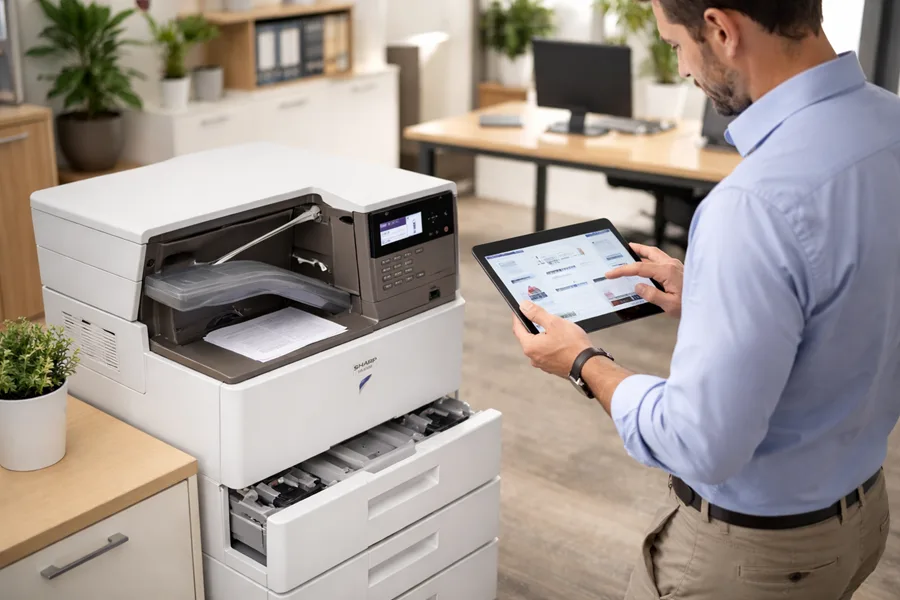
- Secure print release: Ensures documents only print when an authenticated user is present, preventing unattended sensitive pages.
- Data encryption: Protects information in transit and at rest to reduce interception and data-remanence risks.
- Access controls and auditing: Restricts who can print or use device features, while creating logs for compliance and review.
- Firmware and patch management: Keeps device software current to prevent exploitation of known vulnerabilities.
These controls work together to harden printing infrastructure and lower the chance of data exposure via printers. The following subsections explain how each control protects documents and how MPS reduces printer-related risk.
How Does MPS Protect Sensitive Documents and Data?
MPS protects documents through secure-release workflows, encryption, and role-based access so printed material reaches only authorized hands. Secure print release requires authentication — PIN, badge, or credentials — before a queued job prints, preventing sensitive pages from sitting unattended. Encryption of data-in-transit and data-at-rest blocks interception and unauthorized access to device storage, and audit logs provide traceability for compliance or investigations. These controls typically integrate with document management tools and existing network security policies to form a consistent protection layer for printed information.
What Are the Risks of Printer-Related Data Loss and How Does MPS Mitigate Them?
Risks include unauthorized access to device storage, interception of print jobs on the network, and exploitation of unpatched firmware to gain wider network access. MPS mitigates these risks with regular firmware updates, network segmentation for printers, secure configuration baselines, and continuous monitoring to spot anomalies. Treating printers as managed endpoints — with the same patching and lifecycle discipline as other IT assets — reduces the attack surface and lowers the chance of data exposure originating from printing equipment. These controls also help meet regulatory obligations where document confidentiality is required.
How Does Managed Print Services Enhance Productivity and IT Efficiency in Chester County?
MPS boosts productivity by reducing downtime, simplifying user interactions with printers, and enabling faster scanning and document routing to speed workflows. IT efficiency improves because monitoring, maintenance, and supply logistics are centralized, reducing helpdesk volume and the time technicians spend on routine printer tasks. These gains free IT to focus on strategic projects while employees spend less time waiting for prints or manually managing documents. Below are the primary productivity and IT-efficiency benefits MPS delivers.
- Lower helpdesk volume for printer incidents thanks to proactive monitoring and remote troubleshooting.
- Faster issue resolution via alerts, remote diagnostics, and prioritized service workflows.
- Workflow improvements like scan-to-cloud and standardized drivers that speed document handling.
How Does MPS Free Up IT Departments and Reduce Printer Downtime?
MPS shifts monitoring, alert triage, and first-line maintenance to the provider, who handles automated alerts, supplies fulfillment, and scheduled preventive visits. This reduces routine tickets and the need for internal staff to troubleshoot device issues, letting IT focus on core network and application priorities. Service-level agreements and remote diagnostics speed repairs when hardware faults occur, shortening mean time to repair. By outsourcing these tasks, organizations reclaim internal labor hours and minimize the cumulative impact of printer downtime.
What Workflow Optimizations Are Enabled by Printer Fleet Management?
Fleet management enables standardized driver deployments, centralized print queues, scan-to-cloud integration, and mobile printing support that together streamline document processes. Standard drivers reduce compatibility headaches across devices, centralized queues send large color jobs to high-efficiency machines, and OCR-enabled scan workflows speed capture and indexing to reduce manual data entry. These changes shorten process times and improve accuracy for document workflows, reinforcing the productivity gains MPS provides.
Why Choose Associated Imaging Solutions for Managed Print Services in Chester County, PA?
Associated Imaging Solutions (AIS) is a regional partner serving the Philadelphia and Delaware Valley area with copier leasing, rentals, repairs, Managed Print Services, and document management. AIS focuses on cost reduction, security, productivity, sustainability, and responsive local support. For Chester County organizations wanting hands-on regional service, AIS’s local presence (Warminster, PA, and nearby) enables faster onsite response, flexible leasing and rental options, and access to multifunction copiers, laser and desktop printers, and wide-format devices. The section below explains AIS’s local support approach and how its product and leasing options fit typical MPS engagements.
What Local Expertise and Support Does AIS Offer to Chester County Businesses?
AIS provides regional coverage across the Philadelphia/Delaware Valley corridor with hands-on, responsive service that benefits Chester County businesses. Local support means quicker onsite visits and a provider familiar with area firms’ regulatory and operational needs, reducing friction during assessments and rollouts. A nearby partner also simplifies logistics for rentals, repairs, and toner replenishment, helping teams keep devices online without long shipping waits. That proximity supports a collaborative relationship for ongoing optimization and faster problem resolution.
How Does AIS Use Advanced Technology and Flexible Leasing to Tailor MPS Solutions?
AIS’s lineup includes multifunction copiers, laser and desktop printers, and wide-format devices, plus flexible leasing and rental options, repairs, and document management services to meet varied business needs. Flexible leasing lets organizations scale device counts without heavy capital outlay, making it easier to right-size fleets and adopt newer, energy-efficient models. By pairing the right technology with leasing and service, AIS builds managed programs that match device capabilities — like multifunction scanning and secure print release — to clients’ budget and sustainability goals in Chester County.
What Is the Process for Implementing Managed Print Services with AIS in Chester County?
Implementation usually follows three phases: assessment, implementation, and ongoing management — each tailored to the client’s environment to deliver measurable improvements and smooth adoption. The assessment inventories devices and usage, implementation deploys optimized devices, policies, and integrations, and ongoing management provides monitoring, supplies, and reporting to keep improving performance. Working with a local provider like AIS adds regional responsiveness to each phase, ensuring recommendations are practical for Chester County operations. The subsections below outline the core activities in each phase and what to expect during deployment and after go-live.
How Does the Initial Assessment Identify Your Business’s Printing Needs?
An initial assessment captures a device and usage inventory, analyzes print volumes by department, models a cost baseline, and performs a security scan to find exposure points and consolidation opportunities. Auditors gather pages-per-device, color vs. black-and-white ratios, and peak usage times to recommend right-sizing and policy changes. The usual deliverable is a prioritized optimization plan — consolidation, new device placements, and policy enforcement — plus an estimated cost/benefit analysis to guide decisions. That assessment sets the stage for a tailored implementation aligned with operational priorities and budget limits.
What Happens During Implementation and Ongoing Management of MPS?
Implementation includes device deployment, configuration of secure print and reporting tools, user training, and migration of workflows such as scan-to-cloud. After deployment, ongoing management covers automated supply fulfillment, remote monitoring and alerts, scheduled preventive maintenance, and regular reporting on usage, costs, and sustainability metrics. Periodic review meetings check performance against KPIs and identify further optimization opportunities, creating a continuous improvement loop. Local providers handle on-site service when physical intervention is needed, keeping performance steady after go-live.
What Are Common Questions About Managed Print Services in Chester County, PA?
Business leaders often ask about cost drivers, contract inclusions, timelines for ROI, and how to compare providers; clear answers help owners and IT leaders choose wisely. The FAQ below pairs common questions with direct, useful responses that address local concerns and typical contract elements. Where helpful, answers explain how regional providers like AIS support Chester County operations and what to expect from assessments and billing models.
- How much do Managed Print Services cost? Costs depend on device count, monthly volumes, service level, and included features. Many agreements bundle maintenance, supplies, and monitoring into a predictable monthly fee, replacing unpredictable repair and capital expenses with clearer budgeting — and often netting savings through consolidation and reduced waste.
- What services are typically included in an MPS contract? Typical inclusions are maintenance and repairs, automated supply provisioning, device monitoring and alerts, usage reporting, and core security features like secure print release.
- How do I choose an MPS provider? Look for local responsiveness, a full service offering (leasing, rentals, repairs, document management), strong security capabilities, and transparent reporting. Regional partners can often provide faster onsite support when needed.
Intro to the pricing elements table: The following table outlines common pricing elements and typical ranges or examples to help Chester County businesses understand what drives MPS costs.
This table clarifies contract components and how they change print expense models. Below is a short reference table highlighting common pricing elements.
These examples help decision-makers compare proposals and focus on contract transparency and local support capability. The next section covers sustainability and eco-friendly printing.
How Much Do Managed Print Services Cost for Pennsylvania Businesses?
Costs scale with fleet size, print volumes, service levels, and whether you choose fixed monthly billing or cost-per-page arrangements; reviewing these factors shows the most economical structure for your organization. Industry studies often report meaningful percentage reductions in total print spend after consolidation and policy changes, though results vary by operation. Predictable billing converts capital and unexpected repair costs into regular operating expenses, simplifying budgeting. When evaluating proposals, confirm what’s included — supplies, maintenance, monitoring, and reporting — so you can compare offers accurately.
What Services Are Included in a Typical MPS Contract?
A typical MPS contract bundles maintenance and repairs, automated supply provisioning, device monitoring with remote diagnostics, usage reporting, and baseline security measures such as secure print release and basic encryption. Contracts can also include optional document management integrations and flexible leasing for device refreshes or rentals. Clear service-level descriptions and reporting frequency ensure the agreement meets operational needs and gives the transparency required for ongoing optimization.
How Does Managed Print Services Support Sustainability and Eco-Friendly Printing in Chester County?
MPS supports sustainability by setting duplex as the default, enforcing print quotas, consolidating devices to energy-efficient models, and managing recycling for consumables to reduce landfill waste. Measurement matters: reports that track pages saved, duplex rates, and toner recycling volumes provide the data to quantify environmental benefits. For Chester County organizations with sustainability goals, these steps reduce paper use, cut energy consumption, and produce documented metrics for corporate responsibility reporting. The subsection below lists common green initiatives MPS promotes and the measurable outcomes they deliver.
What Green Initiatives Does MPS Promote to Reduce Paper Waste and Energy Use?
Typical MPS green initiatives include default duplex printing, secure print release to avoid accidental prints, consolidating to ENERGY STAR–rated devices, and managed recycling programs for toner and hardware. Default duplexing can significantly lower paper use, while secure release cuts unclaimed pages left on trays. Upgrading to energy-efficient equipment reduces fleet power draw, and managed recycling keeps consumables out of landfills. Together, these steps reduce operating costs and environmental impact, aligning printing practices with broader sustainability goals.
How Can Businesses Track Their Environmental Impact Through MPS?
Businesses track environmental impact with metrics like pages saved, percent duplexed, estimated energy avoided, and consumables recycled; reports can be produced monthly or quarterly to show trends. Dashboards and periodic summaries translate those figures into useful indicators — for example, paper saved or estimated carbon equivalents — helping stakeholders see progress against sustainability targets. Regular reviews of these metrics support continuous improvement and demonstrate the environmental value of MPS investments.
Request a Free MPS Assessment: For Chester County organizations that want a local, tailored review, request a free MPS assessment to establish a baseline and an action plan.
Frequently Asked Questions
What types of businesses can benefit from Managed Print Services?
MPS helps many kinds of organizations — small law firms, medical clinics, schools, and corporate offices all see benefits. Any business that depends on printing can use MPS to optimize its environment, cut costs, and improve productivity. Providers tailor programs to industry needs, addressing compliance, security, and budget constraints so solutions fit each sector.
How long does it take to see results after implementing MPS?
Most organizations begin seeing measurable results within a few months. Early wins often come from lower supply costs and better device utilization. Full benefits — improved efficiency and lower overall operating costs — typically appear as usage patterns stabilize and policies take hold. Regular reporting and follow-up assessments help track progress and uncover further savings.
Can MPS integrate with existing document management systems?
Yes. MPS commonly integrates with document management systems to enable scan-to-cloud workflows and automated routing. Connecting MPS to your existing systems streamlines document handling, improves access, and reduces manual entry. Discuss integration capabilities with your provider to confirm compatibility and maximize value.
What are the environmental benefits of using MPS?
MPS supports sustainability through default duplex printing, device consolidation, and consumable recycling programs. These practices reduce paper waste, cut energy use, and shrink the overall environmental footprint of printing. Tracking metrics like pages saved and energy avoided helps quantify impact and supports corporate responsibility reporting.
How does MPS enhance employee productivity?
MPS reduces downtime and simplifies printer interactions. Proactive monitoring and maintenance mean fewer device failures, and features like centralized queues and scan-to-cloud workflows speed document tasks. Together, these changes let employees focus on core work instead of troubleshooting printers.
What should businesses consider when evaluating MPS providers?
When comparing providers, consider local responsiveness, the breadth of services (leasing, rentals, repairs, document management), security features, and transparency in reporting. Industry experience, customer testimonials, and clear SLAs are also important. A nearby provider can offer faster onsite support and a more collaborative relationship.
Related Posts
— Managed Print Services in Bucks County, PA

— Managed Print Services in Wilmington, DE