

Managed Print Services in Camden, NJ

January 22, 2026
 0 views
 0 comments
Managed Print Services in Camden, NJ: Streamline Your Business Printing with AIS
Managed Print Services (MPS) centralize and simplify your organization’s printing environment so you pay less, suffer fewer interruptions, and keep sensitive documents secure — tailored for Camden, NJ businesses. This guide explains what MPS is, why local organizations benefit from proactive print fleet management, and how modern MPS cuts cost‑per‑page while improving security and supporting sustainability goals. You’ll get a clear look at the core MPS pieces — hardware, software, consumables, and service — plus practical cost tactics like device consolidation and automated toner replenishment, and the security controls that reduce printer‑related risks for regulated industries. We also walk through a practical MPS lifecycle (assessment → implementation → optimization) and energy‑saving choices that matter locally.
Finally, learn how Associated Imaging Solutions (AIS) brings localized MPS and flexible leasing to Camden, highlighting straightforward pricing and around‑the‑clock support. The sections ahead map directly to Camden priorities: benefits, the AIS delivery model, cost strategies and ROI, security and compliance, sustainability practices, and reasons to consider AIS for copier leasing and managed print services.
What Are Managed Print Services and How Do They Benefit Camden Businesses?
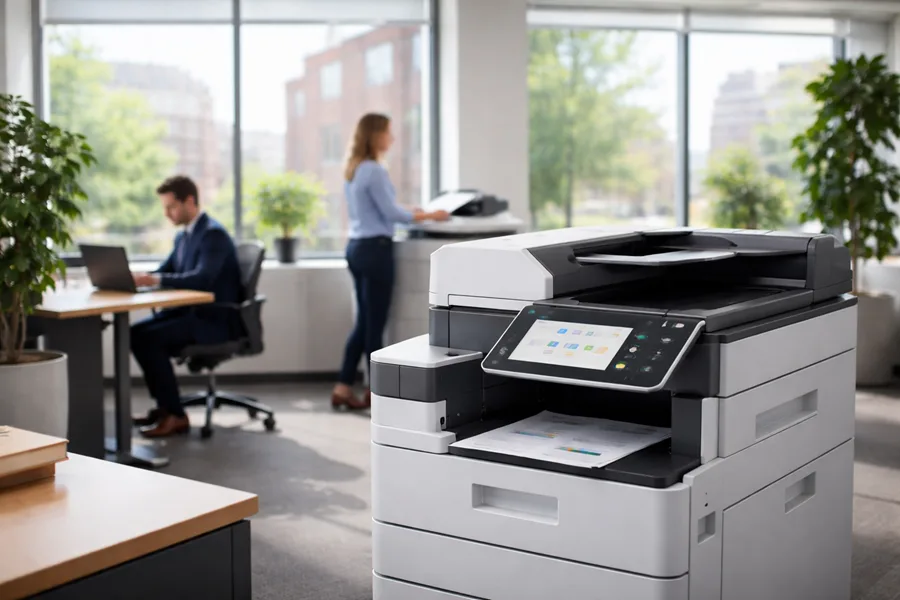
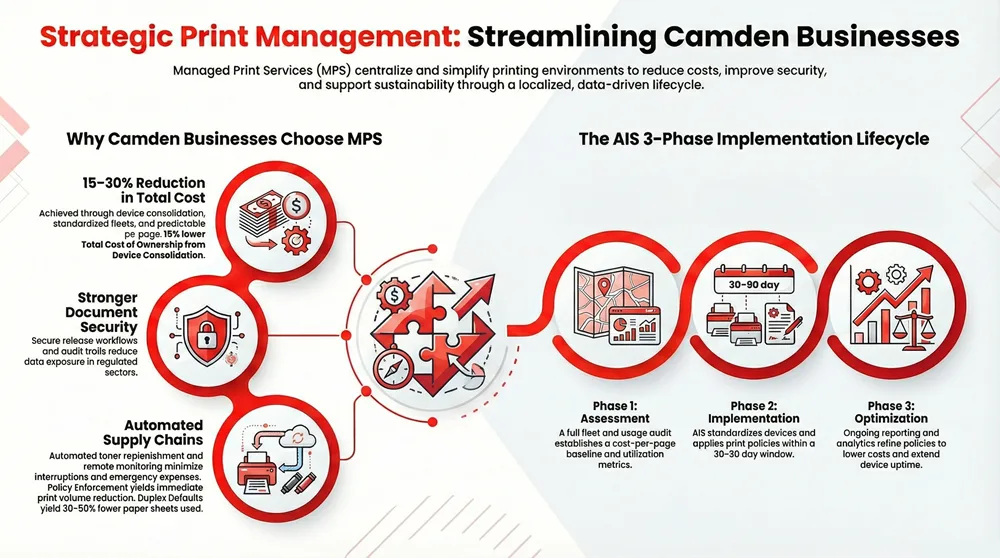
Managed Print Services (MPS) is a proactive program that combines fleet management, automatic supplies replenishment, monitoring software, and vendor‑managed support to lower costs and boost productivity. Instead of ad‑hoc device ownership, MPS puts centralized policies, automated supply chains, and data‑driven insights in place to cut waste and avoid unexpected downtime. Camden organizations gain a lower total cost of ownership, predictable billing for easier budgeting, fewer on‑site disruptions, and stronger document security for regulated sectors. Below are the main ways Camden companies typically benefit from a modern MPS program.
MPS produces measurable results by tackling several cost and operational levers at once. Those mechanisms point directly to the components of a complete MPS solution.
MPS delivers clear advantages for Camden workplaces:
- Lower Costs: Predictable per‑page pricing and device consolidation trim operating expenses.
- Higher Uptime: Remote monitoring and preventive maintenance minimize interruptions.
- Stronger Security: Secure release workflows and audit trails reduce data exposure from printers.
- Sustainability: Default duplexing and toner recycling cut waste and energy use.
These benefits form the practical starting point for implementation, which begins with a detailed inventory and usage analysis.
What Does Managed Print Services Include for Camden, NJ Companies?
MPS covers hardware lifecycle management, supplies fulfillment, automated monitoring, service contracts, and document workflow automation — together forming a practical, end‑to‑end print program. Hardware management focuses on fleet rationalization: right‑sizing multifunction printers (MFPs) and desktop units to actual usage. Supplies fulfillment uses automated toner orders to avoid stockouts and costly rush deliveries. Monitoring software gathers device metrics (pages, errors, alerts) and delivers actionable reports that drive policy changes like default duplexing or grayscale printing. Workflow automation ties scanning, OCR, and routing into digital processes that reduce needless printing and speed document handling.
These technical pieces directly enable cost savings and create clear opportunities for operational gains in Camden operations.
How Can MPS Reduce Printing Costs and Improve Efficiency in Camden?
MPS cuts costs through device consolidation, standardized fleets, per‑page pricing or subscriptions, and policies that change user behavior to reduce waste. Typical savings range from 15–30% depending on the starting environment. Consolidating underused printers into centrally managed MFPs reduces maintenance points and consumable spend. Per‑page or subscription models convert unpredictable capital expenses into steady operating costs. Automated toner replenishment and proactive maintenance lower downtime and emergency expenses, while policy enforcement — default double‑sided printing, grayscale defaults, and secure‑release workflows — quickly reduce print volume. The short comparison below summarizes common tactics and their typical impact for Camden organizations.
These cost‑management approaches and simple metrics help decision‑makers evaluate ROI and shift to a more predictable, efficient print environment.
Research shows that pricing models and provider strategies play a big role in MPS effectiveness and cost efficiency.
Empirical Study on Managed Print Services Pricing and Provider Strategies
This study examines contractual relationships between MPS providers and institutional customers using proprietary data. Findings show customer printing demand is relatively insensitive to service price across observed contracts, and that a customer’s valuation often follows the wider population trend despite industry differences. The research also finds provider contract choices balance expected earnings with earnings variability, suggesting providers act with risk awareness. Overall, the analysis indicates similar risk‑adjusted returns across customer types and hints at competitive pricing dynamics in the market.
Empirical study on managed print services pricing, J Ning, 2014
How Does Associated Imaging Solutions Deliver Managed Print Services in Camden, NJ?
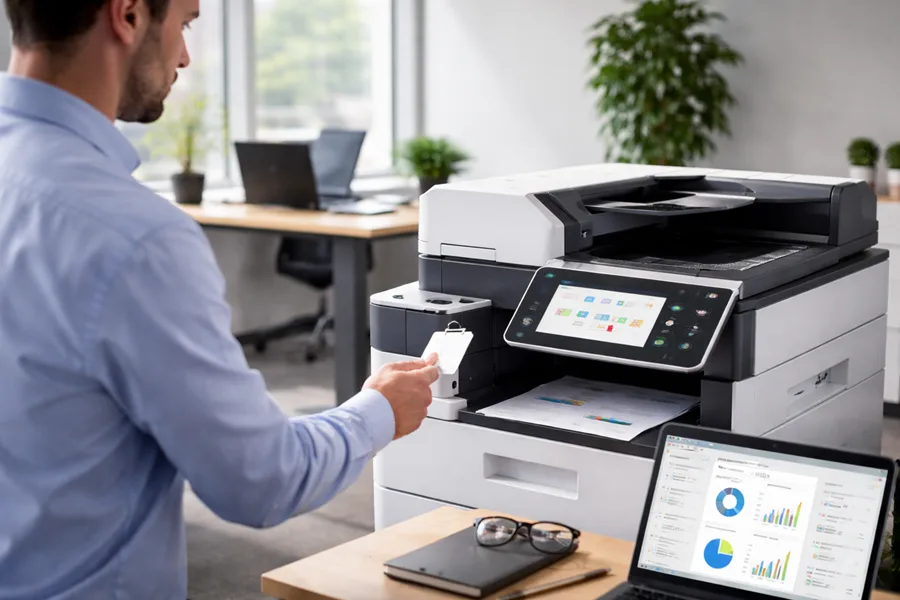
Associated Imaging Solutions (AIS) delivers Managed Print Services through a three‑phase lifecycle — assessment, implementation, and optimization — customized for Camden organizations and backed by leading hardware and software partners. AIS focuses on transparent pricing, flexible leasing options to avoid heavy upfront costs, 24/7 support, and manufacturer partnerships that bring modern, reliable technology. The local delivery model emphasizes fast response and hands‑on fleet care while using analytics to drive continuous improvement and reduce total cost of ownership for Camden clients. Below is a concise breakdown of the AIS MPS workflow and typical deliverables.
AIS applies this process to Camden organizations with an emphasis on measurable KPIs, setting the stage for the technology and brand choices that follow.
What Is the AIS MPS Process: Assessment, Implementation, and Optimization?
The assessment starts with a full fleet audit and usage analysis to set baseline metrics like pages per user and device utilization; this diagnostic phase uncovers consolidation and policy opportunities. Implementation installs print management software, applies security controls, and consolidates devices where it makes sense while configuring automated supplies workflows and service contracts for a smooth transition. Optimization uses ongoing analytics and reporting to refine policies, schedule preventive maintenance, and recommend hardware lifecycle actions that lower cost‑per‑page and extend uptime. Every stage produces documentation and measurable KPIs that help Camden managers justify continued investment.
This phased, data‑driven approach makes sure improvement targets — cost savings, uptime, and security — are tracked and sustained.
Which Advanced Technologies and Printer Brands Does AIS Use in Camden?
Modern MPS depends on proven hardware and analytics platforms. Typical manufacturer options include enterprise‑grade MFPs and laser devices that support secure release, cloud integration, and power‑saving modes. Print management software delivers fleet telemetry, user authentication, and routing to digital workflows, while secure printing options — PIN release, badge authentication, and encryption — protect sensitive output. AIS partners with major brands and integrates print analytics to map device health and usage against business goals, helping Camden clients make smarter leasing and replacement decisions. Picking the right mix of brand, model, and software directly affects cost, security, and sustainability outcomes.
Choosing appropriate technologies also shapes pricing models and supports the long‑term optimization phase of an MPS engagement.
Implementing solid security controls is essential to protecting sensitive digital documents in the office.
Secure Production and Storage of Digital Documents in Office Environments
Chapter 4 outlines a security framework and proposes protocols for secure production and storage of digital documents in office settings, highlighting how technical controls and procedures work together to protect sensitive information.
Secure production and storage of digital documents in an office environment, 2001
How Can Camden Businesses Optimize Print Costs with Managed Print Services?
Start cost optimization with a diagnostic audit to find high‑cost devices and behavior‑driven waste, then apply targeted measures like consolidation, automated supplies, and enforceable print policies. Transparent pricing — per‑page billing, subscriptions, and flexible leasing — turns uncertain capital expenses into predictable operating costs and can speed time‑to‑ROI, often within 6–12 months for small and mid‑size organizations depending on initial inefficiencies. The table below compares common pricing approaches and typical ROI expectations to help Camden decision‑makers choose the right model.
Beyond pricing, operational tactics — automated consumables, policy defaults, and user quotas — further reduce expenses. These are the implementation areas where providers like AIS deliver ongoing support.
What Are Transparent Pricing Models and ROI Expectations for MPS in Camden?
Transparent pricing can mean per‑page billing, subscription bundles, or equipment leasing — each balances capital and operating expenses differently while offering predictable budgets. Per‑page aligns cost with use and eliminates surprise service fees; subscriptions bundle supplies and maintenance into a single monthly charge for easier forecasting. Leasing lowers initial capital needs so businesses can access newer, energy‑efficient devices and refresh fleets more regularly. Camden organizations commonly see ROI in the first year when consolidation and policy enforcement shrink volume and emergency maintenance costs, making transparent models a good fit for budget‑minded teams.
Knowing how each pricing model behaves helps align procurement with financial planning and operational goals.
What Strategies Does AIS Use to Lower Toner, Paper, and Maintenance Expenses?
AIS focuses on automated supplies fulfillment, default duplex and grayscale settings, and proactive maintenance agreements to reduce consumable waste and prevent costly repairs. Automated replenishment trims administrative work and removes rush shipping. Default print settings and user quotas stop unnecessary printing at the source. Proactive service contracts and remote monitoring spot anomalies early so fixes happen before major failures, and maintenance can be scheduled during low‑impact windows. Together, these tactics cut both direct consumable costs and indirect productivity losses from downtime.
These operational improvements pair with pricing choices so savings are repeated and measurable, not one‑time wins.
The printing industry keeps evolving to lower costs and improve output quality.
Cost Reduction and Quality Improvements in the Printing Industry
This study reviews ways the printing industry can cut costs and reduce use of harmful materials, while also improving production quality — a useful reference for organizations seeking both efficiency and environmental gains.
Cost reduction and quality improvements in the printing industry, FJG Silva, 2018
How Does Managed Print Services Enhance Security and Compliance for Camden Offices?
Managed Print Services strengthens security by applying controls such as user authentication, secure print release, encryption, and audit logging so sensitive documents are less likely to be exposed. The basics are simple: authentication ensures only authorized users retrieve output; secure release stops unattended documents; encryption protects data in transit; and logs create an audit trail for regulatory review. For Camden industries that handle protected data — healthcare, legal, or finance — these controls support common compliance needs and make document handling auditable and defensible. The list below summarizes how MPS improves security in office settings.
- Secure Print Release: Requires authentication at the device to prevent unclaimed documents.
- Encryption & Network Hardening: Secures data moving between devices and servers.
- Audit Logs & Reporting: Tracks document events to aid investigations and compliance.
- Access Controls: Restricts device functions to authorized roles.
MPS security measures establish a technical baseline that organizations can reinforce with policy and user training to stay audit‑ready and incident‑prepared.
What Secure Print Solutions Protect Sensitive Documents in Camden, NJ?
Secure print solutions include PIN or badge release, mobile authentication, end‑to‑end encryption between devices and management servers, and role‑based access controls that limit functions like external scanning. Secure release workflows cut the risk of misdirected or uncollected printouts. Encryption and certificate‑based authentication protect document streams on shared networks. Audit trails and activity reports provide the documentation needed for incident response and regulatory review, giving Camden organizations a clear chain of custody. Effective deployment requires coordination across device configuration, network security, and user training.
Putting these device and software controls in place also helps organizations prepare for policy audits and risk assessments.
How Does AIS Ensure Compliance with HIPAA and Other Regulations?
AIS helps clients meet compliance requirements by configuring technical controls — secure release, encryption, and detailed logging — and by providing documented policies and reporting that support regulatory review, without claiming formal certifications on the client’s behalf. An MPS provider’s role includes setting up devices and software for access control, producing regular audit reports, and advising on retention and secure disposal practices for printed materials. For healthcare and other regulated Camden entities, AIS supplies the tools and reporting needed for internal or third‑party validation while recommending that organizations maintain their own compliance governance. Providers enable compliance readiness rather than certify it outright.
These provider‑delivered controls combine with organizational policy and oversight to form an auditable posture for printed information.
What Sustainable Printing Practices Does AIS Offer for Camden, NJ Businesses?
Smart sustainability in printing focuses on using less paper, choosing energy‑efficient hardware, and running recycling programs for consumables and end‑of‑life devices to shrink environmental impact and operating costs. The approach combines policy changes — default duplexing and digital‑first workflows — with hardware choices like ENERGY STAR‑rated printers and toner formulations that use less energy. Measure impact by tracking pages avoided, device energy use, and recycled consumables; these KPIs translate sustainability goals into actionable results. The table below compares common eco options and typical annual benefits to help Camden organizations prioritize actions.
These sustainability steps lower cost and support corporate responsibility goals while guiding procurement toward energy‑efficient models.
How Can Camden Companies Reduce Waste and Carbon Footprint with MPS?
Camden companies can cut waste by setting duplex and grayscale defaults, moving routine approvals to digital workflows, and using secure pull‑printing to eliminate uncollected output. Behavior changes — user training and print quotas — work alongside technical defaults to reduce unnecessary printing. Converting repetitive paper processes to digital forms lowers recurring print volume. To measure carbon impact, track device energy consumption and pages saved; combining those figures creates a clear picture of emissions reductions. These practices lower both operating cost and environmental footprint, creating a twin benefit for the business and the community.
Regular measurement and reporting keep improvements visible and drive continuous gains.
Which Energy-Efficient Printers and Recycling Programs Are Available Locally?
Energy‑efficient printers offer sleep/low‑power modes, fast warm‑up, and ENERGY STAR or equivalent ratings; choosing high‑efficiency models reduces operating costs and supports local sustainability goals. Local recycling programs for toner cartridges and end‑of‑life devices often work with vendors and regional e‑waste collectors to ensure responsible disposal and material recovery. Practical steps include selecting devices with manufacturer recycling programs, scheduling end‑of‑life pick‑ups, and documenting recycling activity for corporate sustainability reporting. These choices reduce waste and help Camden organizations meet environmental targets and procurement policies.
Picking the right devices and recycling partners complements policy‑driven volume reductions to maximize sustainability outcomes.
Why Choose Associated Imaging Solutions for Managed Print Services and Copier Leasing in Camden, NJ?
Associated Imaging Solutions (AIS) is a local partner offering transparent pricing, flexible leasing, 24/7 support, and strong relationships with leading printer brands to deliver modern, cost‑effective MPS for Camden businesses. AIS stands behind “Best Deals Guaranteed and No Hidden Charges,” offers leasing plans to avoid large upfront investments, and provides continuous helpdesk coverage. Local expertise plus modern technology gives Camden organizations access to multi‑brand hardware, analytics‑driven optimization, and eco‑friendly options without the uncertainty of ad‑hoc support. Below we outline AIS’s core value propositions and next steps for teams seeking a free assessment or leasing quote.
These practical offerings reflect what Camden decision‑makers need and lead into local support details and case study availability.
What Local Expertise and 24/7 Support Does AIS Provide to Camden Businesses?
AIS delivers a local service model centered on fast, responsive support, remote monitoring for proactive maintenance, and helpdesk availability to resolve issues quickly and minimize disruption. Onsite technicians paired with analytics‑driven alerts shorten repair times and prioritize high‑impact devices, while 24/7 assistance covers urgent problems outside normal hours. This local presence, combined with global‑brand hardware and modern MPS platforms, supports dependable uptime and service transparency without implying specific SLA guarantees. For Camden clients, local expertise also means hands‑on knowledge of nearby logistics, recycling options, and vendor networks that streamline fleet management.
Those capabilities help Camden organizations keep devices available and operating costs predictable through a managed partnership.
Are There Case Studies Showing Camden Businesses’ Success with AIS MPS?
Camden‑specific case studies may be limited in public listings, but regional examples show measurable outcomes — lower cost‑per‑page, better uptime, and smoother workflows — that Camden organizations can expect from a structured MPS engagement. Prospective clients are encouraged to request a localized assessment or performance summary that quantifies expected savings, pages saved, and security improvements for their environment. AIS can provide regional examples and build a custom ROI model from an initial fleet audit to show projected timelines and payback. Requesting a tailored assessment is the fastest way for Camden businesses to see concrete, measurable projections tied to their usage and goals.
These data‑driven examples help decision‑makers evaluate potential partnerships and estimate the financial and operational impact of moving to managed print services.
Frequently Asked Questions
What are the key factors to consider when choosing a Managed Print Services provider?
Look for industry experience, a full range of services, and the ability to customize solutions to your needs. Prioritize transparent pricing, flexible leasing, and dependable support. Check their technology partners and hardware/software quality, and consider a provider with local presence for faster response and a better grasp of regional logistics.
How can businesses measure the success of their Managed Print Services implementation?
Measure success with KPIs like cost‑per‑page, device uptime, and user satisfaction. Regular audits and reporting show progress over time. Track reductions in paper use and energy consumption to gauge environmental impact. Set clear benchmarks before you start so you can quantify improvements accurately.
What role does employee training play in the effectiveness of Managed Print Services?
Training is essential. Staff need to know how to use new systems and follow print policies — for example, default duplexing and secure release. Good training reduces waste and boosts document security. Regular refresh sessions keep teams aligned with updates and best practices, supporting efficiency and sustainability.
Can Managed Print Services support remote work environments?
Yes. MPS can integrate cloud printing and mobile capabilities so staff print securely from anywhere while staying within company policy. Providers can also offer remote monitoring and management so supplies and maintenance happen without on‑site visits, keeping remote teams productive.
What are the environmental benefits of implementing Managed Print Services?
MPS reduces paper waste, lowers energy use, and improves recycling for consumables. Enforcing duplex printing and digital workflows cuts unnecessary printing, and energy‑efficient devices plus recycling programs shrink your carbon footprint. Tracking these metrics helps companies meet sustainability goals and show corporate responsibility.
How does MPS enhance document security for businesses in regulated industries?
MPS boosts security with user authentication, secure print release, and encryption, ensuring only authorized people access sensitive documents. Audit trails and reporting support regulatory compliance like HIPAA or GDPR. These controls protect data and provide the documentation organizations need for audits and incident response.
Related Posts

— Managed Print Services for Philadelphia Businesses
— Copier Leasing in University City, Philadelphia